PDF · English
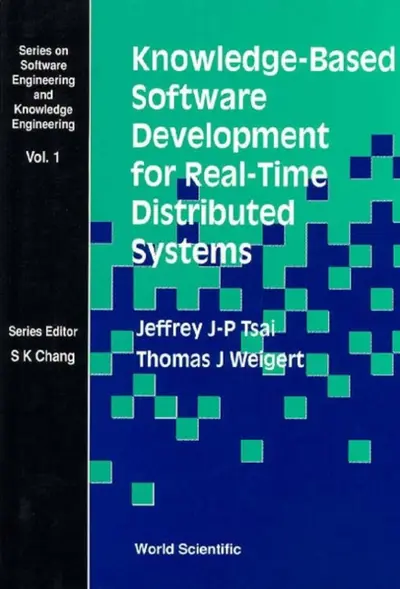
Knowledge-based Software Development For Real-time Distributed Systems
Price and availability
$54.99
Available in: Andorra, Austria, Australia, Belgium, Bulgaria, Canada, Switzerland, Cyprus, Czechia, Germany, Denmark, Estonia, Spain, Finland, France, United Kingdom, Guernsey, Greece, Croatia, Hungary, Ireland, Isle of Man, Iceland, Italy, Jersey, Japan, Liechtenstein, Lithuania, Luxembourg, Latvia, Monaco, Malta, Netherlands, Norway, Poland, Portugal, Romania, Sweden, Slovenia, Slovakia, San Marino, United States, Vatican City, South Africa
Stores: US, UK, Canada, EU, Australia.
Sign in to buyThe price is re-checked by the server before payment.
For personal use under the eBook licence.
- Format
- DRM
- Not stated by the publisher
- Language
- English
- Publisher
- World Scientific Publishing Company
- Published
- 22 November 1993
- Pages
- 236
- ISBN
- 9789814505222
- Subjects
- Software Engineering, Computer science, Artificial intelligence, Software Engineering, Computer science, Artificial intelligence (AI)
About this book
The interplay of artificial intelligence and software engineering has been an interesting and an active area in research institution and industry. This book covers the state of the art in the use of knowledge-based approaches for software specification, design, implementation, testing and debugging. Starting with an introduction to various software engineering paradigms and knowledge-based software systems, the book continues with the discussion of using hybrid knowledge representation as a basis to specify software requirements, to facilitate specification analysis and transformation of real-time distributed software systems. A formal requirements specification language using non-monotonic logic, temporal logic, frames and production systems for new software engineering paradigms (such as rapid prototyping, operational specification and transformational implementation) is also discussed in detail. Examples from switching and other applications are used to illustrate the requirements language. Finally, the development, specification and verification of knowledge-based systems are investigated.
Bibliographic data © Gardners Books Ltd.