PDF · English
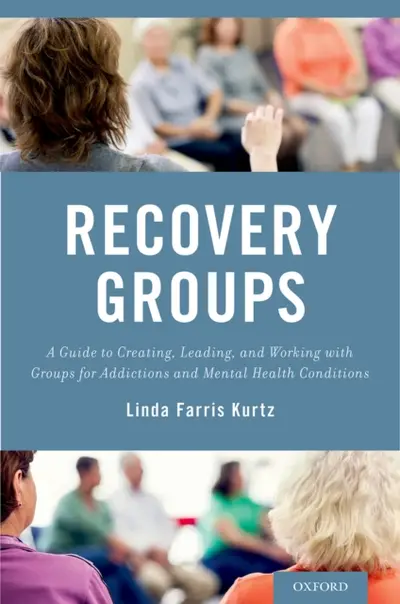
Recovery Groups
A Guide to Creating, Leading, and Working With Groups For Addictions and Mental Health Conditions
Price and availability
$35.99
Available in: Andorra, Austria, Australia, Belgium, Bulgaria, Canada, Switzerland, Cyprus, Czechia, Germany, Denmark, Estonia, Spain, Finland, France, United Kingdom, Guernsey, Greece, Croatia, Hungary, Ireland, Isle of Man, Iceland, Italy, Jersey, Japan, Liechtenstein, Lithuania, Luxembourg, Latvia, Monaco, Malta, Netherlands, Norway, Poland, Portugal, Romania, Sweden, Slovenia, Slovakia, San Marino, United States, Vatican City, South Africa
Stores: US, UK, Canada, EU, Australia.
Sign in to buyThe price is re-checked by the server before payment.
For personal use under the eBook licence.
- Format
- DRM
- Not stated by the publisher
- Language
- English
- Publisher
- Oxford University Press
- Published
- 31 October 2014
- ISBN
- 9780199362981
- Subjects
- Clinical psychology, Addiction & therapy, MKM, MKZR
About this book
This book focuses on community self-help and support groups specifically in the context of recovery movements in addiction and mental health care. The idea of groups of recovering people meeting together may seem like a simple one and not one requiring much effort and thought; however, as this book will show, this is not the case. In Recovery Groups: A Guide to Creating, Leading, and Working with Groups for Addictions and Mental Health Conditions Linda Kurtz breaks down the recovery movement for addictions and mental health care into three sections. In the first section recovery concepts are broken down into two fields: how they differ and how they come together. The second section focuses on methods of working with independent self-help groups and leadership in support groups. Kurtz touches on the study of helping mechanisms, social climate, group teachings, group structure, and how to use each of these to improve group performance. In the third section of the book, Kurtz examines social and community actions from members involved in Twelve-Step fellowships and consumer survivor organizations. The final section also details programs that provide employment, housing, and mutual support, explaining how to accomplish these goals without a large expense. This book will be useful to students, professional mental health and addiction workers, recovery coaches and peer support specialists, and group members and leaders who are interested in this topic.
Bibliographic data © Gardners Books Ltd.