PDF · English
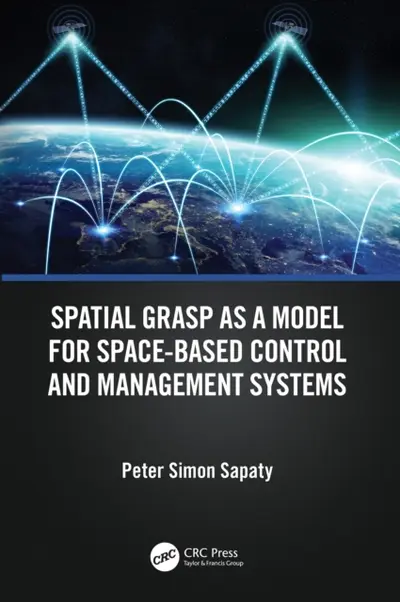
Spatial Grasp as a Model for Space-based Control and Management Systems
Price and availability
$82.99
Available in: Andorra, Austria, Australia, Belgium, Bulgaria, Canada, Switzerland, Cyprus, Czechia, Germany, Denmark, Estonia, Spain, Finland, France, United Kingdom, Guernsey, Greece, Croatia, Hungary, Ireland, Isle of Man, Iceland, Italy, Jersey, Japan, Liechtenstein, Lithuania, Luxembourg, Latvia, Monaco, Malta, Netherlands, Norway, Poland, Portugal, Romania, Sweden, Slovenia, Slovakia, San Marino, United States, Vatican City, South Africa
Stores: US, UK, Canada, EU, Australia.
Sign in to buyThe price is re-checked by the server before payment.
For personal use under the eBook licence.
- Format
- DRM
- Not stated by the publisher
- Language
- English
- Publisher
- CRC Press
- Published
- 23 June 2022
- ISBN
- 9781000600636
- Subjects
- Engineering: general, Electrical engineering, Communications engineering / telecommunications, Mobile phone technology, WAP (wireless) technology, Environmental science, engineering & technology, Aerospace & aviation technology, Space science, Astronautics, Information technology: general issues, Legal aspects of IT, Computer security, Computer networking & communications, Network security, Computer architecture & logic design, The Solar System, Astronautics, Computer programming / software engineering, Distributed systems / Distributed computing
About this book
Governmental agencies and private companies of different countries are actively moving into space around Earth with the aim to provide smart communication and industry, security, and defense solutions. This often involves massive launches of small, cheap satellites in low earth orbits, which is also contributing to the growth of space debris. The book offers a high-level holistic system philosophy, model, and technology that can effectively organize distributed space-based systems, starting with their planning, creation, and growth. The Spatial Grasp Technology described in the book, based on parallel navigation and pattern-matching of distributed environments with high-level recursive mobile code, can effectively provide any networking protocols and important system applications, by integrating and tasking available terrestrial and celestial equipment. This book contains practical examples of technology-based solutions for tracing hypersonic gliders, continuing observation of certain objects and infrastructures on Earth from space, space-based command and control of large distributed systems, as well as collective removal of increasing amounts of space junk. Earlier versions of this technology were prototyped and used in different countries, with the current version capable of being quickly implemented in traditional industrial or even university environments. This book is oriented toward system scientists, application programmers, industry managers, and university students interested in advanced MSc and PhD projects related to space conquest and distributed system management.Dr Peter Simon Sapaty, Chief Research Scientist, Ukrainian Academy of Sciences, has worked with networked systems for five decades. Outside of Ukraine, he has worked in the former Czechoslovakia (now Czech Republic and Slovakia), Germany, the UK, Canada, and Japan as a group leader, Alexander von Humboldt researcher, and invited and visiting professor. He launched and chaired the Special Interest Group (SIG) on Mobile Cooperative Technologies in Distributed Interactive Simulation project in the United States, and invented a distributed control technology that resulted in a European patent and books with Wiley, Springer, and Emerald. He has published more than 250 papers on distributed systems and has been included in the Marquis Who's Who in the World and Cambridge Outstanding Intellectuals of the 21st Century. Peter also works with several international scientific journals.
Bibliographic data © Gardners Books Ltd.