EPUB · English
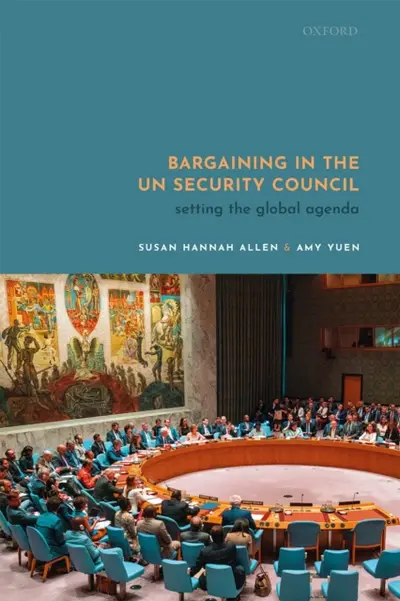
Bargaining in the UN Security Council
Setting the Global Agenda
Price and availability
$87.99
Available in: Andorra, Austria, Australia, Belgium, Bulgaria, Canada, Switzerland, Cyprus, Czechia, Germany, Denmark, Estonia, Spain, Finland, France, United Kingdom, Guernsey, Greece, Croatia, Hungary, Ireland, Isle of Man, Iceland, Italy, Jersey, Japan, Liechtenstein, Lithuania, Luxembourg, Latvia, Monaco, Malta, Netherlands, Norway, Poland, Portugal, Romania, Sweden, Slovenia, Slovakia, San Marino, United States, Vatican City, South Africa
Stores: US, UK, Canada, EU, Australia.
Sign in to buyThe price is re-checked by the server before payment.
For personal use under the eBook licence.
- Format
- EPUB
- DRM
- Not stated by the publisher
- Language
- English
- Publisher
- Oxford University Press
- Published
- 14 February 2022
- ISBN
- 9780192666604
- Subjects
- Political structures: democracy, Diplomacy, International institutions, United Nations & UN agencies, Political structures / systems: democracy, Diplomacy, International institutions / intergovernmental organizations
About this book
Even after seventy-five years, the UN Security Council meets nearly every day. They respond to a range of threats to international peace and security, but not all threats. Why does the Security Council take up some issues for discussion and not others? What factors shape the Council's actions, if they take any action at all? Adapting insights from legislative bargaining, this book demonstrates that the agenda-setting powers granted in the institutional rules offer less powerful Council members the opportunity to influence the content of a resolution without jeopardizing its passage. The Council also decides when to conduct public or private diplomacy. The analysis shows how external factors like international and domestic public reactions motivate grandstanding behaviors and shape resolutions. New quantitative data on meetings and outside options provide support for these claims. The book also explores the dynamics of the formal analysis in three cases: North Korean nuclear proliferation, the negotiations leading up to NATO bombing in Serbia over Kosovo, and the elected member-led process to codify the principles of the Responsibility to Protect doctrine. The book argues that while the powerful veto members do have great influence over the Council, the rules of the most consequential security institution influence its policy outcomes, just as they do in any other international institution.
Bibliographic data © Gardners Books Ltd.