PDF · English
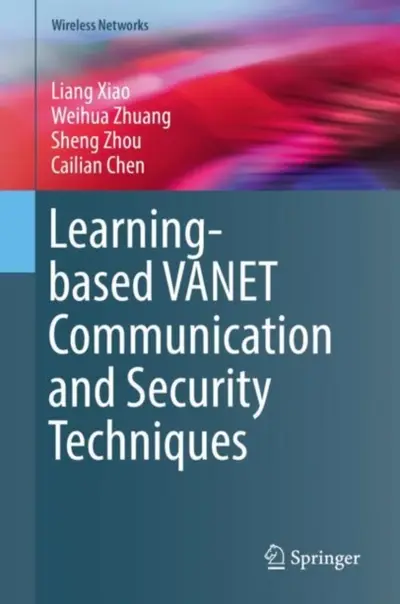
Learning-based VANET Communication and Security Techniques
Price and availability
$120.99
Available in: Andorra, Austria, Australia, Belgium, Bulgaria, Canada, Switzerland, Cyprus, Czechia, Germany, Denmark, Estonia, Spain, Finland, France, United Kingdom, Guernsey, Greece, Croatia, Hungary, Ireland, Isle of Man, Iceland, Italy, Jersey, Japan, Liechtenstein, Lithuania, Luxembourg, Latvia, Monaco, Malta, Netherlands, Norway, Poland, Portugal, Romania, Sweden, Slovenia, Slovakia, San Marino, United States, Vatican City, South Africa
Stores: US, UK, Canada, EU, Australia.
Sign in to buyThe price is re-checked by the server before payment.
For personal use under the eBook licence.
- Format
- DRM
- Not stated by the publisher
- Language
- English
- Publisher
- Springer International Publishing
- Published
- 29 October 2018
- ISBN
- 9783030017316
- Subjects
- Intelligent & automated transport system technology, Computer security, Computer networking & communications, Communications engineering / telecommunications, WAP (wireless) technology, Computer security, Network security, Artificial intelligence (AI)
About this book
This timely book provides broad coverage of vehicular ad-hoc network (VANET) issues, such as security, and network selection. Machine learning based methods are applied to solve these issues. This book also includes four rigorously refereed chapters from prominent international researchers working in this subject area. The material serves as a useful reference for researchers, graduate students, and practitioners seeking solutions to VANET communication and security related issues. This book will also help readers understand how to use machine learning to address the security and communication challenges in VANETs. Vehicular ad-hoc networks (VANETs) support vehicle-to-vehicle communications and vehicle-to-infrastructure communications to improve the transmission security, help build unmanned-driving, and support booming applications of onboard units (OBUs). The high mobility of OBUs and the large-scale dynamic network with fixed roadside units (RSUs) make the VANET vulnerable to jamming. The anti-jamming communication of VANETs can be significantly improved by using unmanned aerial vehicles (UAVs) to relay the OBU message. UAVs help relay the OBU message to improve the signal-to-interference-plus-noise-ratio of the OBU signals, and thus reduce the bit-error-rate of the OBU message, especially if the serving RSUs are blocked by jammers and/or interference, which is also demonstrated in this book.This book serves as a useful reference for researchers, graduate students, and practitioners seeking solutions to VANET communication and security related issues.
Bibliographic data © Gardners Books Ltd.