PDF · English
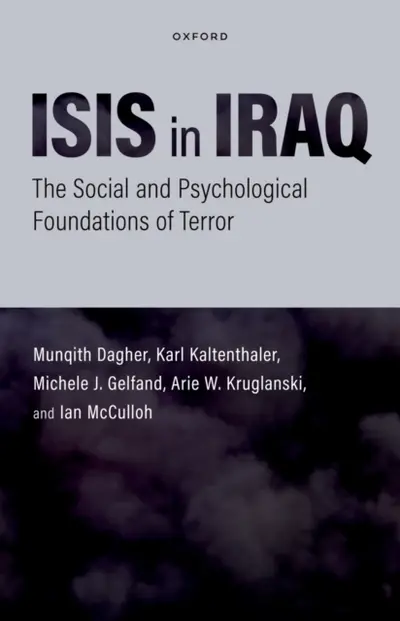
ISIS in Iraq
The Social and Psychological Foundations of Terror
Price and availability
$44.99
Available in: Andorra, Austria, Australia, Belgium, Bulgaria, Canada, Switzerland, Cyprus, Czechia, Germany, Denmark, Estonia, Spain, Finland, France, United Kingdom, Guernsey, Greece, Croatia, Hungary, Ireland, Isle of Man, Iceland, Italy, Jersey, Japan, Liechtenstein, Lithuania, Luxembourg, Latvia, Monaco, Malta, Netherlands, Norway, Poland, Portugal, Romania, Sweden, Slovenia, Slovakia, San Marino, United States, Vatican City, South Africa
Stores: US, UK, Canada, EU, Australia.
Sign in to buyThe price is re-checked by the server before payment.
For personal use under the eBook licence.
- Format
- DRM
- Not stated by the publisher
- Language
- English
- Publisher
- Oxford University Press
- Published
- 16 May 2023
- ISBN
- 9780197524763
- Subjects
- Iraq, Social, group or collective psychology, Espionage & secret services, Social, group or collective psychology, Espionage and secret services
About this book
The Islamic State in Iraq and Syria (ISIS) gained control over large swathes of Iraq in the summer of 2014 at a breathtaking rate. At the time many rightly wondered how ISIS was able to claim so much territory in the Sunni-dominated portion of Iraq so quickly. Just as unexpected, however, was the downfall of ISIS; by 2017, their hold on the region had crumbed with ISIS focusing on avoiding complete annihilation. This book explores the social and psychological factors behind how ISIS was able to rise in Iraq, control most of it, and why most of that population eventually turned on it. Synthesized by some of the foremost experts on terrorism, the analysis is based on a unique array of public opinion data from surveys, focus groups, and interviews. The authors explain why some Iraqis acquiesced to ISIS while others opposed it, why ISIS lost the hearts and minds of Iraqi Sunni Arabs, and ultimately how this contributed to its battlefield defeats. The in-depth face-to-face interviews with ISIS members are a particularly rich source of data, supplementing empirical findings to draw lessons as to what individual and societal-level factors contribute to radicalization and what can be done to counter radicalization and support deradicalization.
Bibliographic data © Gardners Books Ltd.