EPUB · English
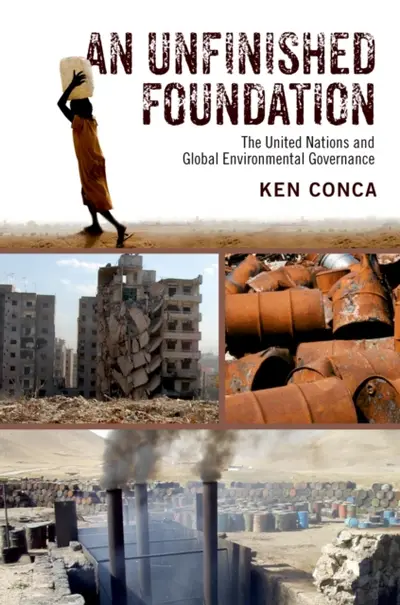
Unfinished Foundation
The United Nations and Global Environmental Governance
Price and availability
$37.99
Available in: Andorra, Austria, Australia, Belgium, Bulgaria, Canada, Switzerland, Cyprus, Czechia, Germany, Denmark, Estonia, Spain, Finland, France, United Kingdom, Guernsey, Greece, Croatia, Hungary, Ireland, Isle of Man, Iceland, Italy, Jersey, Japan, Liechtenstein, Lithuania, Luxembourg, Latvia, Monaco, Malta, Netherlands, Norway, Poland, Portugal, Romania, Sweden, Slovenia, Slovakia, San Marino, United States, Vatican City, South Africa
Stores: US, UK, Canada, EU, Australia.
Sign in to buyThe price is re-checked by the server before payment.
For personal use under the eBook licence.
- Format
- EPUB
- DRM
- Not stated by the publisher
- Language
- English
- Publisher
- Oxford University Press
- Published
- 13 July 2015
- ISBN
- 9780190232887
- Subjects
- Peace studies & conflict resolution, United Nations & UN agencies, The environment, GTU, JPSN, The environment
About this book
Why is the United Nations not more effective on global environmental challenges? The UN Charter mandates the global organization to seek four noble aspirations: international peace and security, rule of law among nations, human rights for all people, and social progress through development. On environmental issues, however, the UN has understood its charge much more narrowly: it works for "e;better law between nations"e; and "e;better development within them."e; This approach treats peace and human rights as unrelated to the world's environmental problems, despite a large body of evidence to the contrary. In this path-breaking book, a leading scholar of global environmental governance critiques the UN's failure to use its mandates on human rights and peace as tools in its environmental work. The book traces the institutionalization and performance of the UN's "e;law and development"e; framework and the parallel silence on rights and peace. Despite some important gains, the traditional approach is failing for some of world's most pressing and contentious environmental challenges, and has lost most of the political momentum it once enjoyed. The disastrous "e;Rio+20"e; Summit laid this fact bare, as assembled governments failed to find meaningful agreement on any of the most pressing issues. By not treating the environment as a human rights issue, the UN fails to mobilize powerful tools for accountability in the face of pollution and resource degradation. And by ignoring the conflict potential around natural resources and environmental protection efforts, the UN misses opportunities to transform the destructive cycle of violence and vulnerability around resource extraction. The book traces the history of the UN's traditional approach, maps its increasingly apparent limits, and suggests needed reforms. Detailed case histories for each of the four mandate domains flag several promising initiatives, while identifying barriers to transformation. Its core implication: the UN's environmental efforts require not just a managerial reorganization but a conceptual revolution-one that brings to bear the full force of the organization's mandate. Peacebuilding, conflict sensitivity, rights-based frameworks, and accountability mechanisms can be used to enhance the UN's environmental effectiveness and legitimacy.
Bibliographic data © Gardners Books Ltd.