EPUB · English
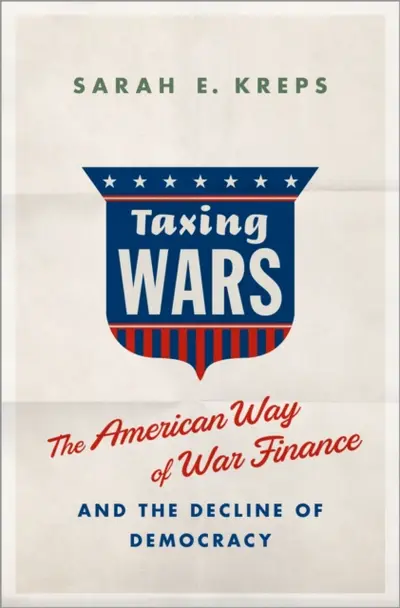
Taxing Wars
The American Way of War Finance and the Decline of Democracy
Price and availability
$33.99
Available in: Andorra, Austria, Australia, Belgium, Bulgaria, Canada, Switzerland, Cyprus, Czechia, Germany, Denmark, Estonia, Spain, Finland, France, United Kingdom, Guernsey, Greece, Croatia, Hungary, Ireland, Isle of Man, Iceland, Italy, Jersey, Japan, Liechtenstein, Lithuania, Luxembourg, Latvia, Monaco, Malta, Netherlands, Norway, Poland, Portugal, Romania, Sweden, Slovenia, Slovakia, San Marino, United States, Vatican City, South Africa
Stores: US, UK, Canada, EU, Australia.
Sign in to buyThe price is re-checked by the server before payment.
For personal use under the eBook licence.
- Format
- EPUB
- DRM
- Not stated by the publisher
- Language
- English
- Publisher
- Oxford University Press
- Published
- 1 May 2018
- ISBN
- 9780190865320
- Subjects
- The Americas, North America, Political science & theory, Terrorism, armed struggle, Armed conflict, Warfare & defence, Public finance, The Americas, North America (USA and Canada), Political science and theory, Terrorism, armed struggle, Armed conflict, Warfare and defence, Public finance and taxation
About this book
Why have the wars in Afghanistan and Iraq lasted longer than any others in American history? The conventional wisdom suggests that the move to an all-volunteer force and unmanned technologies such as drones have reduced the apparent burden of war so much that they have allowed these conflicts to continue almost unnoticed for years. Taxing Wars suggests that the burden in blood is just one side of the coin. The way Americans bear the burden in treasure has also changed, and these changes have both eroded accountability and contributed to the phenomenon of perpetual war. Sarah Kreps chronicles the entire history of how America has paid for its wars-and how its methods have changed. Early on, the United States imposed war taxes that both demanded sacrifices from all Americans and served as reminders of their participation. Indeed, thinkers from Immanuel Kant to Adam Smith argued that these reminders were exactly the reason why democracies tended to fight shorter and less costly wars. Bearing these burdens caused the populace to sue for peace when the costs mounted. Leaders in a democracy, responsive to their citizens, would have incentives to heed that opposition and bring wars to as expeditious an end as possible. Since the Korean War, the United States has increasingly moved away from war taxes. Instead, borrowing-and its comparatively less visible connection with the war-has become a permanent feature of contemporary wars. The move serves leaders well because reducing the apparent burden of war has helped mute public opposition and any decision-making constraints. But by masking accountability, however, the move away from war taxes undermines the basis for democratic restraint in wartime. Contemporary wars have become correspondingly longer and costlier as the public has become disconnected from those burdens. Given the trends identified in Taxing Wars, the recent past-epitomized by our lengthy wars in Afghanistan and Iraq-is likely to be prologue.
Bibliographic data © Gardners Books Ltd.