PDF · English
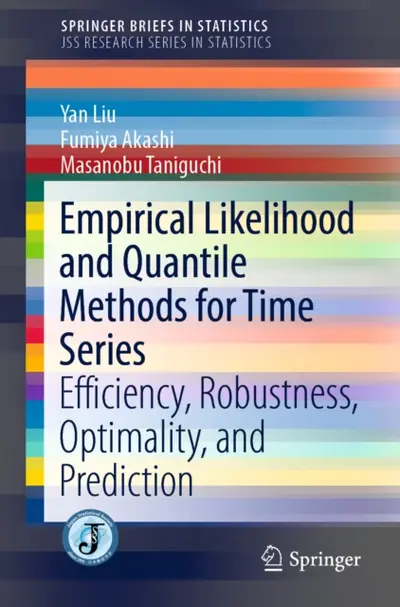
Empirical Likelihood and Quantile Methods for Time Series
Efficiency, Robustness, Optimality, and Prediction
Price and availability
$67.99
Available in: Andorra, Austria, Australia, Belgium, Bulgaria, Canada, Switzerland, Cyprus, Czechia, Germany, Denmark, Estonia, Spain, Finland, France, United Kingdom, Guernsey, Greece, Croatia, Hungary, Ireland, Isle of Man, Iceland, Italy, Jersey, Japan, Liechtenstein, Lithuania, Luxembourg, Latvia, Monaco, Malta, Netherlands, Norway, Poland, Portugal, Romania, Sweden, Slovenia, Slovakia, San Marino, United States, Vatican City, South Africa
Stores: US, UK, Canada, EU, Australia.
Sign in to buyThe price is re-checked by the server before payment.
For personal use under the eBook licence.
- Format
- DRM
- Not stated by the publisher
- Language
- English
- Publisher
- Springer Nature Singapore
- Published
- 5 December 2018
- ISBN
- 9789811001529
- Subjects
- Social research & statistics, Economic statistics, Probability & statistics, Social research and statistics, Economics, Finance, Business and Management, Probability and statistics
About this book
This book integrates the fundamentals of asymptotic theory of statistical inference for time series under nonstandard settings, e.g., infinite variance processes, not only from the point of view of efficiency but also from that of robustness and optimality by minimizing prediction error. This is the first book to consider the generalized empirical likelihood applied to time series models in frequency domain and also the estimation motivated by minimizing quantile prediction error without assumption of true model. It provides the reader with a new horizon for understanding the prediction problem that occurs in time series modeling and a contemporary approach of hypothesis testing by the generalized empirical likelihood method. Nonparametric aspects of the methods proposed in this book also satisfactorily address economic and financial problems without imposing redundantly strong restrictions on the model, which has been true until now. Dealing with infinite variance processes makesanalysis of economic and financial data more accurate under the existing results from the demonstrative research. The scope of applications, however, is expected to apply to much broader academic fields. The methods are also sufficiently flexible in that they represent an advanced and unified development of prediction form including multiple-point extrapolation, interpolation, and other incomplete past forecastings. Consequently, they lead readers to a good combination of efficient and robust estimate and test, and discriminate pivotal quantities contained in realistic time series models.
Bibliographic data © Gardners Books Ltd.