PDF · English
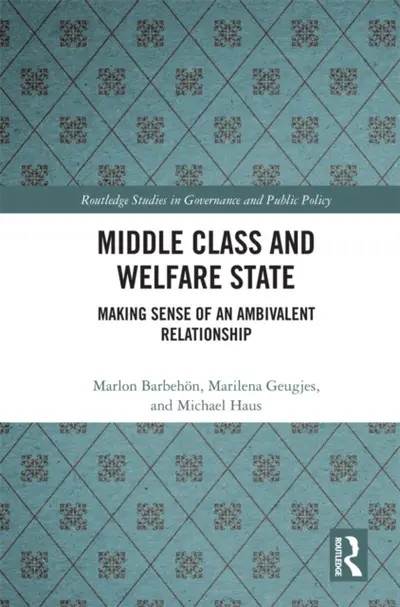
Middle Class and Welfare State
Making Sense of an Ambivalent Relationship
Price and availability
$59.99
Available in: Andorra, Austria, Australia, Belgium, Bulgaria, Canada, Switzerland, Cyprus, Czechia, Germany, Denmark, Estonia, Spain, Finland, France, United Kingdom, Guernsey, Greece, Croatia, Hungary, Ireland, Isle of Man, Iceland, Italy, Jersey, Japan, Liechtenstein, Lithuania, Luxembourg, Latvia, Monaco, Malta, Netherlands, Norway, Poland, Portugal, Romania, Sweden, Slovenia, Slovakia, San Marino, United States, Vatican City, South Africa
Stores: US, UK, Canada, EU, Australia.
Sign in to buyThe price is re-checked by the server before payment.
For personal use under the eBook licence.
- Format
- DRM
- Not stated by the publisher
- Language
- English
- Publisher
- Taylor & Francis
- Published
- 24 March 2020
- ISBN
- 9781000059649
- Subjects
- Europe, Social classes, Social welfare & social services, Comparative politics, Central government policies, Svealand, Sociology, Social welfare, social policy and social services, Public administration / Public policy
About this book
This book examines the relationship between the middle class and the welfare state. Taking an interpretive approach which understands the middle class as a socially constructed category, it combines discourse analysis, welfare state theory, and interpretive policy analysis in an innovative way to investigate how the middle class becomes a meaningful object of public debates and policymaking. Comparing Germany, Sweden, and the United Kingdom, the book reconstructs the prevalent images and meanings of the middle class from each country's public debates and tracks how the middle classes with their various meanings and characteristics are entangled with the identification of societal problems, the articulation of political demands, and the construction of welfare policies. Ultimately, it shows how the formation and consolidation of different welfare regimes can be interpreted as specific ways of solving the puzzle of how to incorporate the middle class in the construction of a welfare state consensus. This book will be of key interest to scholars and students of comparative welfare state research, policy analysis, political sociology, political theory, and European and comparative politics.
Bibliographic data © Gardners Books Ltd.