PDF · English
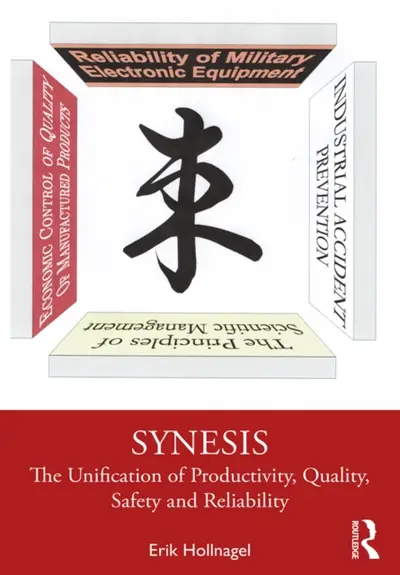
Synesis
The Unification of Productivity, Quality, Safety and Reliability
Price and availability
$45.99
Available in: Andorra, Austria, Australia, Belgium, Bulgaria, Canada, Switzerland, Cyprus, Czechia, Germany, Denmark, Estonia, Spain, Finland, France, United Kingdom, Guernsey, Greece, Croatia, Hungary, Ireland, Isle of Man, Iceland, Italy, Jersey, Japan, Liechtenstein, Lithuania, Luxembourg, Latvia, Monaco, Malta, Netherlands, Norway, Poland, Portugal, Romania, Sweden, Slovenia, Slovakia, San Marino, United States, Vatican City, South Africa
Stores: US, UK, Canada, EU, Australia.
Sign in to buyThe price is re-checked by the server before payment.
For personal use under the eBook licence.
- Format
- DRM
- Not stated by the publisher
- Language
- English
- Publisher
- Taylor & Francis
- Published
- 6 October 2020
- ISBN
- 9781000166552
- Subjects
- Quality Assurance (QA) & Total Quality Management (TQM), Production & quality control management, Health & safety issues, Civil engineering, surveying & building, Quality Assurance (QA) and Total Quality Management (TQM), Organizational theory and behaviour, Health and safety in the workplace
About this book
The complexity of today's large organisations, businesses, and social institutions defeats management approaches based on monolithic thinking. Most industry and service organisations look at their performance either from a single perspective - productivity, quality, safety, etc. - or from different but separate perspectives that reside in organisational silos. Quality is treated separately from safety, which, again, is treated separately from productivity, and so on. While siloed thinking may be convenient in the short term, it fails to recognise that any specific perspective reveals only a part of what goes on. Yet it is essential to have a unified view of how an organisation functions effectively to manage changes and to ensure the organisation excels in what it does.Synesis represents the mutually dependent set of priorities, perspectives, and practices that an organisation needs to carry out its activities as intended. It shows how to overcome the fragmentation in foci, scope, and time that characterises the dominant change management paradigms. This book is consequently not about productivity or quality or safety or reliability but about all of these together. It is about why it is necessary to think of them as a whole. And it is about how this can be done in practice.
Bibliographic data © Gardners Books Ltd.