EPUB · English
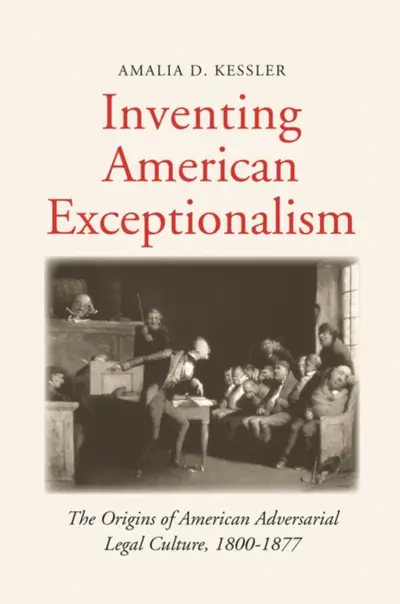
Inventing American Exceptionalism
The Origins of American Adversarial Legal Culture, 1800-1877
Price and availability
$47.99
Available in: Andorra, Austria, Australia, Belgium, Bulgaria, Canada, Switzerland, Cyprus, Czechia, Germany, Denmark, Estonia, Spain, Finland, France, United Kingdom, Guernsey, Greece, Croatia, Hungary, Ireland, Isle of Man, Iceland, Italy, Jersey, Japan, Liechtenstein, Lithuania, Luxembourg, Latvia, Monaco, Malta, Netherlands, Norway, Poland, Portugal, Romania, Sweden, Slovenia, Slovakia, San Marino, United States, Vatican City, South Africa
Stores: US, UK, Canada, EU, Australia.
Sign in to buyThe price is re-checked by the server before payment.
For personal use under the eBook licence.
- Format
- EPUB
- DRM
- Not stated by the publisher
- Language
- English
- Publisher
- Yale University Press
- Published
- 10 January 2017
- Pages
- 448
- ISBN
- 9780300224849
- Subjects
- USA, c 1800 to c 1900, History of the Americas, Modern history to 20th century: c 1700 to c 1900, Legal history, Legal system: general, United States of America, USA, 3MN, Legal history, Legal systems: general, NH, NHK
About this book
A highly engaging account of the developments—not only legal, but also socioeconomic, political, and cultural—that gave rise to Americans’ distinctively lawyer-driven legal culture When Americans imagine their legal system, it is the adversarial trial—dominated by dueling larger-than-life lawyers undertaking grand public performances—that first comes to mind. But as award-winning author Amalia Kessler reveals in this engrossing history, it was only in the turbulent decades before the Civil War that adversarialism became a defining American practice and ideology, displacing alternative, more judge-driven approaches to procedure. By drawing on a broad range of methods and sources—and by recovering neglected influences (including from Europe)—the author shows how the emergence of the American adversarial legal culture was a product not only of developments internal to law, but also of wider socioeconomic, political, and cultural debates over whether and how to undertake market regulation and pursue racial equality. As a result, adversarialism came to play a key role in defining American legal institutions and practices, as well as national identity.
Bibliographic data © Gardners Books Ltd.