EPUB · English
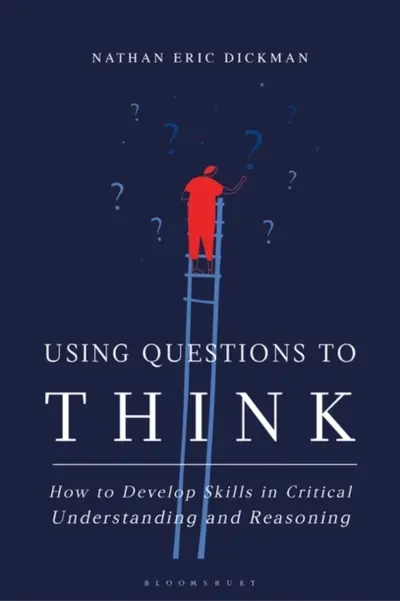
Using Questions to Think
How to Develop Skills in Critical Understanding and Reasoning
Price and availability
$29.99
Available in: Andorra, Austria, Australia, Belgium, Bulgaria, Canada, Switzerland, Cyprus, Czechia, Germany, Denmark, Estonia, Spain, Finland, France, United Kingdom, Guernsey, Greece, Croatia, Hungary, Ireland, Isle of Man, Iceland, Italy, Jersey, Japan, Liechtenstein, Lithuania, Luxembourg, Latvia, Monaco, Malta, Netherlands, Norway, Poland, Portugal, Romania, Sweden, Slovenia, Slovakia, San Marino, United States, Vatican City, South Africa
Stores: US, UK, Canada, EU, Australia.
Sign in to buyThe price is re-checked by the server before payment.
For personal use under the eBook licence.
- Format
- EPUB
- DRM
- Not stated by the publisher
- Language
- English
- Publisher
- Bloomsbury Publishing
- Published
- 6 May 2021
- Pages
- 288
- ISBN
- 9781350177703
- Subjects
- Literature: history & criticism, Philosophy: logic, Philosophy of mind, Literature: history and criticism, QDTL, QDTM
About this book
Our ability to think, argue and reason is determined by our ability to question. Questions are a vital component of critical thinking, yet we underestimate the role they play. Using Questions to Think puts questioning back in the spotlight.Naming the parts of questions at the same time as we name parts of thought, this one-of-a-kind introduction allows us to see how questions relate to the definitions of propositions, premises, conclusions, and the validity of arguments. Why is this important? Making the role of questions visible in thinking reasoning and dialogue, allows us to:- Ask better questions- Improve our capability to understand an argument - Exercise vigilance in the act of questioning- Make explicit what you already know implicitly- Engage with ideas that contradict our own- See ideas in broader contextBreathing new life into our current approach to critical thinking, this practical, much-needed textbook moves us away from the traditional focus on formal argument and fallacy identification, combines the Kantian critique of reason with Hans-Georg Gadamer's hermeneutics and reminds us why thinking can only be understood as an answer to a question.
Bibliographic data © Gardners Books Ltd.