PDF · English
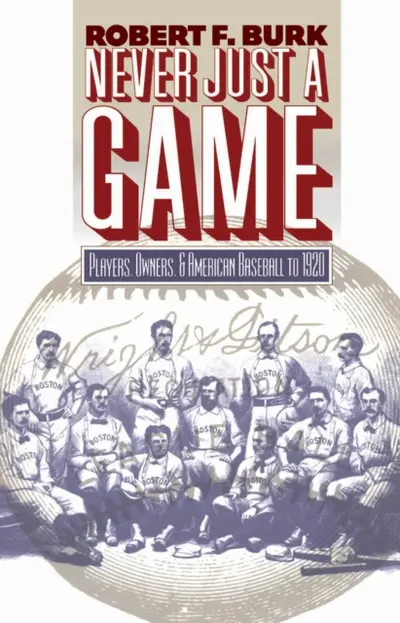
Never Just a Game
Players, Owners, and American Baseball to 1920
Price and availability
$40.99
Available in: Andorra, Austria, Australia, Belgium, Bulgaria, Canada, Switzerland, Cyprus, Czechia, Germany, Denmark, Estonia, Spain, Finland, France, United Kingdom, Guernsey, Greece, Croatia, Hungary, Ireland, Isle of Man, Iceland, Italy, Jersey, Japan, Liechtenstein, Lithuania, Luxembourg, Latvia, Monaco, Malta, Netherlands, Norway, Poland, Portugal, Romania, Sweden, Slovenia, Slovakia, San Marino, United States, Vatican City, South Africa
Stores: US, UK, Canada, EU, Australia.
Sign in to buyThe price is re-checked by the server before payment.
For personal use under the eBook licence.
- Format
- DRM
- Not stated by the publisher
- Language
- English
- Publisher
- The University of North Carolina Press
- Published
- 9 November 2000
- ISBN
- 9798890865298
- Subjects
- USA, History of the Americas, Social & cultural history, Labour economics, Economic history, Baseball, United States of America, USA, Labour / income economics, Industrial relations, occupational health and safety, History of the Americas, History of sport, Baseball
About this book
Americas national pastime has been marked from its inception by bitter struggles between owners and players over profit, power, and prestige. In this book, the first installment of a highly readable, comprehensive labor history of baseball, Robert Burk describes the evolution of the ballplaying work force: its ethnocultural makeup, its economic position, and its battles for a place at the table in baseballs decision-making structure.In the late nineteenth and early twentieth centuries, the growing popularity of baseball as a spectator sport and the dramatic upsurge of Americas urban population created conditions that led to franchise competition, the development of rival leagues, and trade wars, in turn triggering boom-and-bust cycles, franchise bankruptcies, and league mergers. According to Burk, players repeatedly tried to use these circumstances to better their economic positions by playing one team off against another. Their successes proved short-lived, however, because their own internal divisions, exploited by management, undercut attempts to create collective-bargaining institutions. By 1920, owners still held the upper hand in the labor-management battle, but as todays sports pages show, owners did not secure a long-term solution to their labor problems.
Bibliographic data © Gardners Books Ltd.