EPUB · English
Performing Paramilitarism
Loyalist Songs, Conflict, and Culture War in Northern Ireland
Price and availability
$25.99
Available in: Andorra, Austria, Australia, Belgium, Bulgaria, Canada, Switzerland, Cyprus, Czechia, Germany, Denmark, Estonia, Spain, Finland, France, United Kingdom, Guernsey, Greece, Croatia, Hungary, Ireland, Isle of Man, Iceland, Italy, Jersey, Japan, Liechtenstein, Lithuania, Luxembourg, Latvia, Monaco, Malta, Netherlands, Norway, Poland, Portugal, Romania, Sweden, Slovenia, Slovakia, San Marino, United States, Vatican City, South Africa
Stores: US, UK, Canada, EU, Australia.
Sign in to buyThe price is re-checked by the server before payment.
For personal use under the eBook licence.
- Format
- EPUB
- DRM
- Not stated by the publisher
- Language
- English
- Publisher
- Oxford University Press
- Published
- 16 August 2024
- ISBN
- 9780197686447
- Subjects
- Northern Ireland, c 1945 to c 2000 (Post-war period), 20th century & contemporary classical music, Non-Western music: traditional & "classical", British & Irish history, Postwar 20th century history, from c 1945 to c 2000, Sociology: customs & traditions, Social & cultural anthropology, ethnography, 3MPQ, AVLA, JHB, Social and cultural anthropology, NH, NHD
About this book
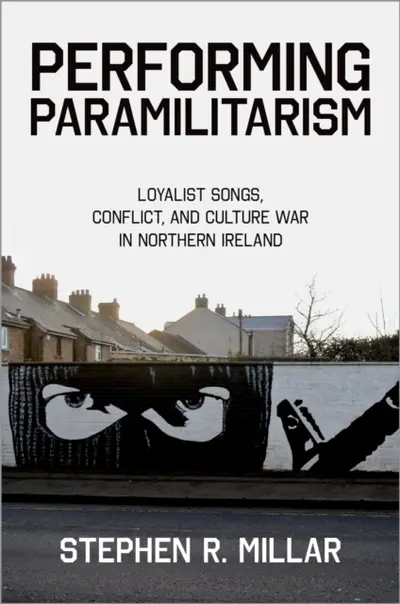
During Northern Ireland's 'Troubles' (1969-98), paramilitary groups were supported and sustained by a sociocultural apparatus that helped legitimise their position within the community and disseminate their political message. From the use of flags and murals to loyalist and republican parades, working-class vernacular culture revealed who controlled various districts of the Province. For many working-class Protestants, loyalist songs were a key component of this culture, connecting the past and the present. Unlike the better-known loyalist marching band scene, the loyalist song scene was--and continues to be--much more private. Performances take place in closed settings such as local loyalist pubs and clubs, where songs are reproduced for internal consumption rather than outward expression. Performing Paramilitarism examines the role that loyalist songs played during the Troubles and why musicians and audiences still produce and consume these songs today. By tracing the connection between loyalist songs and loyalist paramilitaries, the book highlights how these songs feed into a broader 'culture war' in Northern Ireland where, in the absence of intercommunal violence, the commemoration of paramilitary groups is used to continue the conflict by other means. Stephen R. Millar argues that in the wake of Brexit, such songs form part of a cultural nostalgia for multiple and intersecting imagined pasts. These pasts in turn resonate with the rise of populism in other parts of the world and are weaponized to defend against the looming existential threat of a United Ireland.
Bibliographic data © Gardners Books Ltd.