EPUB · English
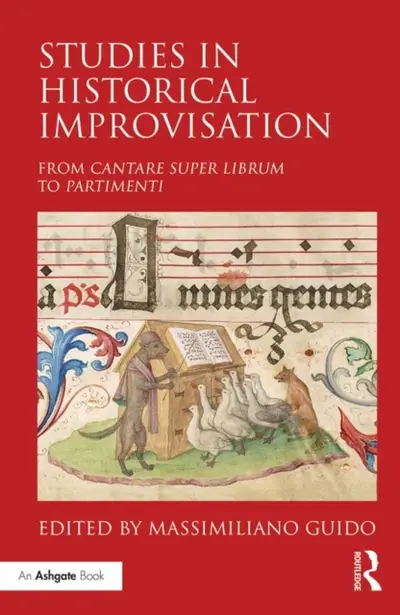
Studies in Historical Improvisation
From Cantare super Librum to Partimenti
Price and availability
$70.99
Available in: Andorra, Austria, Australia, Belgium, Bulgaria, Canada, Switzerland, Cyprus, Czechia, Germany, Denmark, Estonia, Spain, Finland, France, United Kingdom, Guernsey, Greece, Croatia, Hungary, Ireland, Isle of Man, Iceland, Italy, Jersey, Japan, Liechtenstein, Lithuania, Luxembourg, Latvia, Monaco, Malta, Netherlands, Norway, Poland, Portugal, Romania, Sweden, Slovenia, Slovakia, San Marino, United States, Vatican City, South Africa
Stores: US, UK, Canada, EU, Australia.
Sign in to buyThe price is re-checked by the server before payment.
For personal use under the eBook licence.
- Format
- EPUB
- DRM
- Not stated by the publisher
- Language
- English
- Publisher
- Taylor & Francis
- Published
- 6 January 2017
- ISBN
- 9781317048930
- Subjects
- Music, Music reviews & criticism, Medieval & Renaissance music (c 1000 to c 1600), Baroque music (c 1600 to c 1750), Theory of music and musicology, History of music, Techniques of music / music tutorials / teaching of music
About this book
In recent years, scholars and musicians have become increasingly interested in the revival of musical improvisation as it was known in the Renaissance and Baroque periods. This historically informed practice is now supplanting the late Romantic view of improvised music as a rhapsodic endeavour-a musical blossoming out of the capricious genius of the player-that dominated throughout the twentieth century. In the Renaissance and Baroque eras, composing in the mind (alla mente) had an important didactic function. For several categories of musicians, the teaching of counterpoint happened almost entirely through practice on their own instruments. This volume offers the first systematic exploration of the close relationship among improvisation, music theory, and practical musicianship from late Renaissance into the Baroque era. It is not a historical survey per se, but rather aims to re-establish the importance of such a combination as a pedagogical tool for a better understanding of the musical idioms of these periods. The authors are concerned with the transferral of historical practices to the modern classroom, discussing new ways of revitalising the study and appreciation of early music. The relevance and utility of such an improvisation-based approach also changes our understanding of the balance between theoretical and practical sources in the primary literature, as well as the concept of music theory itself. Alongside a word-centred theoretical tradition, in which rules are described in verbiage and enriched by musical examples, we are rediscovering the importance of a music-centred tradition, especially in Spain and Italy, where the music stands alone and the learner must distil the rules by learning and playing the music. Throughout its various sections, the volume explores the path of improvisation from theory to practice and back again.
Bibliographic data © Gardners Books Ltd.