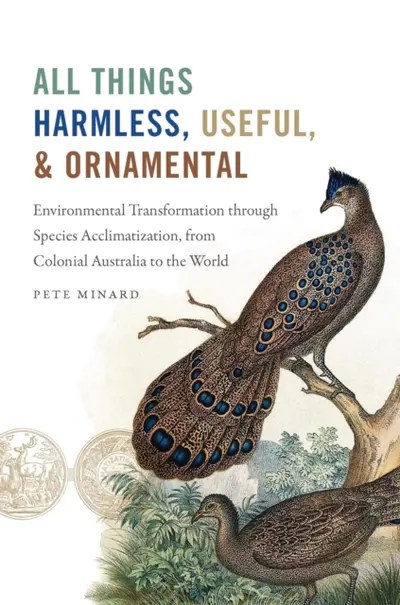
EPUB · English
All Things Harmless, Useful, and Ornamental
Environmental Transformation through Species Acclimatization, from Colonial Australia to the World
Price and availability
$155.99
Available in: Andorra, Austria, Australia, Belgium, Bulgaria, Canada, Switzerland, Cyprus, Czechia, Germany, Denmark, Estonia, Spain, Finland, France, United Kingdom, Guernsey, Greece, Croatia, Hungary, Ireland, Isle of Man, Iceland, Italy, Jersey, Japan, Liechtenstein, Lithuania, Luxembourg, Latvia, Monaco, Malta, Netherlands, Norway, Poland, Portugal, Romania, Sweden, Slovenia, Slovakia, San Marino, United States, Vatican City, South Africa
Stores: US, UK, Canada, EU, Australia.
Sign in to buyThe price is re-checked by the server before payment.
For personal use under the eBook licence.
- Format
- EPUB
- DRM
- Not stated by the publisher
- Language
- English
- Publisher
- The University of North Carolina Press
- Published
- 17 June 2019
- ISBN
- 9781469651637
- Subjects
- Australasia, Oceania & other land areas, South Australia, Modern period, c 1500 onwards, c 1800 to c 1900, Australasian & Pacific history, Modern history to 20th century: c 1700 to c 1900, Archaeology, History of science, Applied ecology, Australia and New Zealand / Aotearoa, General and world history, Australasian and Pacific history, Physical geography and topography, The Earth: natural history: general interest
About this book
Species acclimatization the organized introduction of organisms to a new region is much maligned in the present day. However, colonization depended on moving people, plants, and animals from place to place, and in centuries past, scientists, landowners, and philanthropists formed acclimatization societies to study local species and conditions, form networks of supporters, and exchange supposedly useful local and exotic organisms across the globe.Pete Minard tells the story of this movement, arguing that the colonies, not the imperial centers, led the movement for species acclimatization. Far from attempting to re-create London or Paris, settlers sought to combine plants and animals to correct earlier environmental damage and to populate forests, farms, and streams to make them healthier and more productive. By focusing particularly on the Australian colony of Victoria, Minard reveals a global network of would-be acclimatizers, from Britain and France to Russia and the United States. Although the movement was short-lived, the long reach of nineteenth-century acclimatization societies continues to be felt today, from choked waterways to the uncontrollable expansion of European pests in former colonies.
Bibliographic data © Gardners Books Ltd.