PDF · English
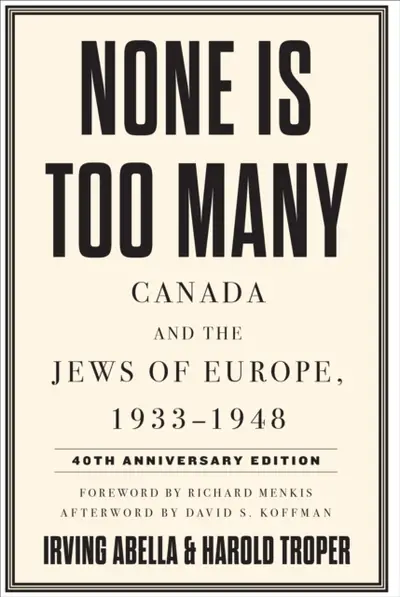
None Is Too Many
Canada and the Jews of Europe, 1933–1948
Price and availability
$36.99
Available in: Andorra, Austria, Australia, Belgium, Bulgaria, Canada, Switzerland, Cyprus, Czechia, Germany, Denmark, Estonia, Spain, Finland, France, United Kingdom, Guernsey, Greece, Croatia, Hungary, Ireland, Isle of Man, Iceland, Italy, Jersey, Japan, Liechtenstein, Lithuania, Luxembourg, Latvia, Monaco, Malta, Netherlands, Norway, Poland, Portugal, Romania, Sweden, Slovenia, Slovakia, San Marino, United States, Vatican City, South Africa
Stores: US, UK, Canada, EU, Australia.
Sign in to buyThe price is re-checked by the server before payment.
For personal use under the eBook licence.
- Format
- DRM
- Not stated by the publisher
- Language
- English
- Publisher
- University of Toronto Press
- Published
- 31 August 2023
- Pages
- 464
- ISBN
- 9781487554392
- Subjects
- Europe, Canada, History of the Americas, Jewish studies, Canada, JBSR, NHK
About this book
Today, we think of Canada as a compassionate, open country to which refugees from other countries have always been welcome. However, between the years 1933 and 1948, when the Jews of Europe were looking for a place of refuge from Nazi persecution, Canada refused to offer aid, let alone sanctuary, to those in fear for their lives.Rigorously documented and brilliantly researched, None Is Too Many tells the story of Canada's response to the plight of European Jews during the Nazi era and its immediate aftermath, exploring why and how Canada turned its back and hardened its heart against the entry of Jewish refugees. Recounting a shameful period in Canadian history, Irving Abella and Harold Troper trace the origins and results of Canadian immigration policies towards Jews and conclusively demonstrate that the forces against admitting them were pervasive and rooted in antisemitism.First published in 1983, None Is Too Many has become one of the most significant books ever published in Canada. This fortieth anniversary edition celebrates the book's ongoing impact on public discourse, generating debate on ethics and morality in government, the workings of Canadian immigration and refugee policy, the responsibility of bystanders, righting historical wrongs, and the historian as witness. Above all, the reader is asked: "e;What kind of Canada do we want to be?"e;This new anniversary edition features a foreword by Richard Menkis on the impact the book made when it was first published and an afterword by David Koffman explaining why the book remains critical today.
Bibliographic data © Gardners Books Ltd.