EPUB · English
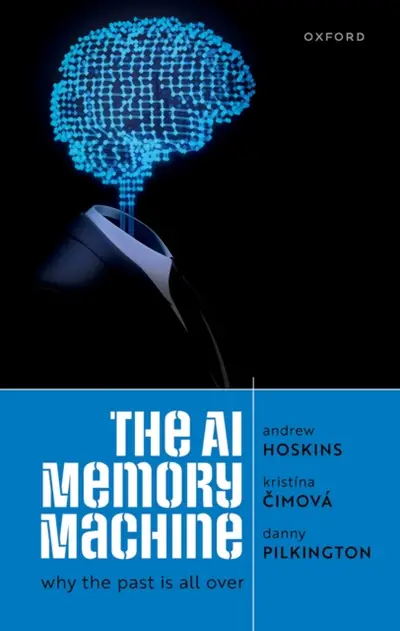
AI Memory Machine
Why the past is all over
Price and availability
$24.99
Available in: Andorra, Austria, Australia, Belgium, Bulgaria, Canada, Switzerland, Cyprus, Czechia, Germany, Denmark, Estonia, Spain, Finland, France, United Kingdom, Guernsey, Greece, Croatia, Hungary, Ireland, Isle of Man, Iceland, Italy, Jersey, Japan, Liechtenstein, Lithuania, Luxembourg, Latvia, Monaco, Malta, Netherlands, Norway, Poland, Portugal, Romania, Sweden, Slovenia, Slovakia, San Marino, United States, Vatican City, South Africa
Stores: US, UK, Canada, EU, Australia.
Sign in to buyThe price is re-checked by the server before payment.
For personal use under the eBook licence.
- Format
- EPUB
- DRM
- Not stated by the publisher
- Language
- English
- Publisher
- Oxford University Press
- Published
- 8 September 2026
- ISBN
- 9780198995890
- Subjects
- Cognition & cognitive psychology, Memory, Artificial intelligence, Cognition and cognitive psychology, Artificial intelligence (AI)
About this book
The AI Memory Machine tells the story of the forces and consequences of the twenty-first century's AI machinic revolution of memory. Generative AI has turbocharged the technologies of memory to find, capture, and mine the individual as the pre-eminent commodity of this age. It is a paradoxical set of social and technological conditions for memory, guided by the framework of capitalism. Your past is already digitally marketed and exploited, with every message, like, and swipe accumulating a life already shared, traceable, hackable, saleable, and memorable. This new AI industry of memory determines who controls the memory machine, through the apps, platforms, devices, and services, which enable our capturing, sharing, and re-generation of data and information about ourselves and experiences. This work tackles these machinic and human transformations through engaging in interdisciplinary sociological and human science approaches to memory studies. Drawing on interviews with experts in the industry of memory, it shows how memory technologies and wider algorithmic processes of data, duplicate, displace, and substitute for the once human. As the AI Memory Machine messes with the cognitive and social forces and boundaries of remembering, is the past already all over? Or does it give new hope in the revelatory potential of what can now be found and seen anew?
Bibliographic data © Gardners Books Ltd.