EPUB · English
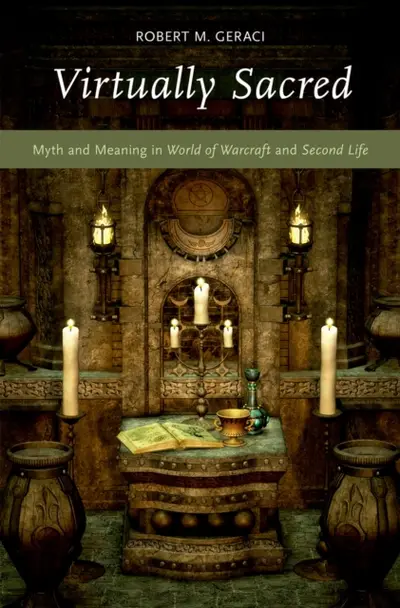
Virtually Sacred
Myth and Meaning in World of Warcraft and Second Life
Price and availability
$48.99
Available in: Andorra, Austria, Australia, Belgium, Bulgaria, Canada, Switzerland, Cyprus, Czechia, Germany, Denmark, Estonia, Spain, Finland, France, United Kingdom, Guernsey, Greece, Croatia, Hungary, Ireland, Isle of Man, Iceland, Italy, Jersey, Japan, Liechtenstein, Lithuania, Luxembourg, Latvia, Monaco, Malta, Netherlands, Norway, Poland, Portugal, Romania, Sweden, Slovenia, Slovakia, San Marino, United States, Vatican City, South Africa
Stores: US, UK, Canada, EU, Australia.
Sign in to buyThe price is re-checked by the server before payment.
For personal use under the eBook licence.
- Format
- EPUB
- DRM
- Not stated by the publisher
- Language
- English
- Publisher
- Oxford University Press
- Published
- 13 June 2014
- ISBN
- 9780199379972
- Subjects
- Alternative belief systems, Sociology, Virtual worlds, Virtual reality, Sociology, QRY, Virtual worlds, Virtual reality
About this book
Millions of users have taken up residence in virtual worlds, and in those worlds they find opportunities to revisit and rewrite their religious lives. Robert M. Geraci argues that virtual worlds and video games have become a locus for the satisfaction of religious needs, providing many users with devoted communities, opportunities for ethical reflection, a meaningful experience of history and human activity, and a sense of transcendence. Using interviews, surveys, and his own first-hand experience within the virtual worlds, Geraci shows how World of Warcraft and Second Life provide participants with the opportunity to rethink what it means to be religious in the contemporary world. Not all participants use virtual worlds for religious purposes, but many online residents use them to rearrange or replace religious practice as designers and users collaborate in the production of a new spiritual marketplace. Using World of Warcraft and Second Life as case studies, this book shows that many residents now use virtual worlds to re-imagine their traditions and work to restore them to "e;authentic"e; sanctity, or else replace religious institutions with virtual communities that provide meaning and purpose to human life. For some online residents, virtual worlds are even keys to a post-human future where technology can help us transcend mortal life. Geraci argues that World of Warcraft and Second Life are "e;virtually sacred"e; because they do religious work. They often do such work without regard for-and frequently in conflict with-traditional religious institutions and practices; ultimately they participate in our sacred landscape as outsiders, competitors, and collaborators.
Bibliographic data © Gardners Books Ltd.