PDF · English
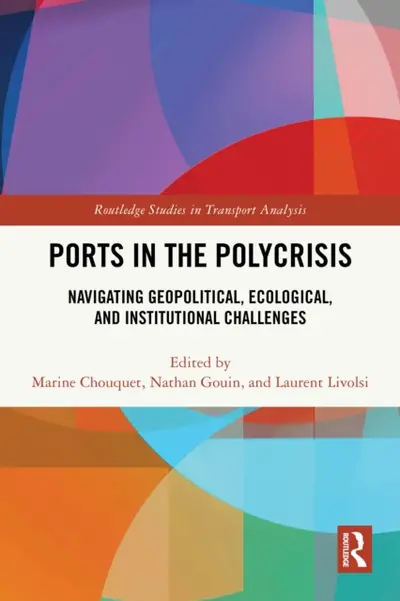
Ports in the Polycrisis
Navigating Geopolitical, Ecological, and Institutional Challenges
- Politics & law
- Economics, business & finance
- Nature, environment & geography
- Technology & engineering
- Lifestyle, food & travel
Price and availability
$64.99
Available in: Andorra, Austria, Australia, Belgium, Bulgaria, Canada, Switzerland, Cyprus, Czechia, Germany, Denmark, Estonia, Spain, Finland, France, United Kingdom, Guernsey, Greece, Croatia, Hungary, Ireland, Isle of Man, Iceland, Italy, Jersey, Japan, Liechtenstein, Lithuania, Luxembourg, Latvia, Monaco, Malta, Netherlands, Norway, Poland, Portugal, Romania, Sweden, Slovenia, Slovakia, San Marino, United States, Vatican City, South Africa
Stores: US, UK, Canada, EU, Australia.
Sign in to buyThe price is re-checked by the server before payment.
For personal use under the eBook licence.
- Format
- DRM
- Not stated by the publisher
- Language
- English
- Publisher
- Taylor & Francis
- Published
- 17 April 2026
- ISBN
- 9781040869918
- Subjects
- Economics, finance, business & management, Purchasing & supply management, Transport industries, Human geography, Transport planning & policy, Civil engineering, surveying & building, Transport: general interest, Ships & boats: general interest, World, Public international law: law of the sea, Coasts and Coastlines, Transport planning and policy
About this book
This book examines how seaports, once emblematic drivers of globalisation and growth, are being transformed by a convergence of geopolitical, environmental, and societal crises. Rather than analysing each disruption separately, it adopts the lens of polycrisis, highlighting the interconnections between supply chain fragility, climate transition, shifting economic models, and social tensions.Contributors from geography, law and management provide a multidisciplinary overview of port mutations, focusing on geopolitical reconfigurations, ecological constraints, and institutional change. The book explores issues such as reshoring and national security, the decline of fossil-fuel-based port economies, conflicts over land use and infrastructure, climate resilience, and the redefinition of port-city relations. By offering an integrated understanding of current transitions, the book provides readers with analytical tools to grasp how crises reinforce each other and reshape ports' functions, governance, and spatial dynamics. It invites new ways of thinking about ports not only as infrastructures of exchange, but as strategic, political, and ecological actors in a world of accelerating change.The primary readership includes academics and researchers in transport geography, port studies, maritime economics, political geography, environmental policy and public law. It will also interest professionals in port authorities, logistics, maritime industries, and policymakers involved in transport, territorial planning and the green transition.
Bibliographic data © Gardners Books Ltd.