EPUB · English
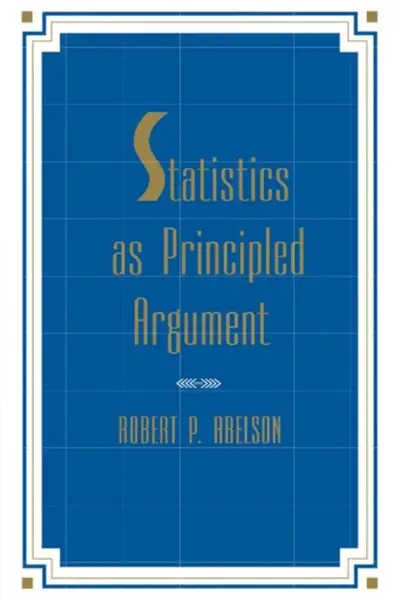
Statistics As Principled Argument
Price and availability
$56.99
Available in: Andorra, Austria, Australia, Belgium, Bulgaria, Canada, Switzerland, Cyprus, Czechia, Germany, Denmark, Estonia, Spain, Finland, France, United Kingdom, Guernsey, Greece, Croatia, Hungary, Ireland, Isle of Man, Iceland, Italy, Jersey, Japan, Liechtenstein, Lithuania, Luxembourg, Latvia, Monaco, Malta, Netherlands, Norway, Poland, Portugal, Romania, Sweden, Slovenia, Slovakia, San Marino, United States, Vatican City, South Africa
Stores: US, UK, Canada, EU, Australia.
Sign in to buyThe price is re-checked by the server before payment.
For personal use under the eBook licence.
- Format
- EPUB
- DRM
- Not stated by the publisher
- Language
- English
- Publisher
- Taylor & Francis
- Published
- 10 September 2012
- ISBN
- 9781135694418
- Subjects
- Psychology, Psychological methodology, Probability & statistics, Research methods / methodology, Probability and statistics
About this book
In this illuminating volume, Robert P. Abelson delves into the too-often dismissed problems of interpreting quantitative data and then presenting them in the context of a coherent story about one's research. Unlike too many books on statistics, this is a remarkably engaging read, filled with fascinating real-life (and real-research) examples rather than with recipes for analysis. It will be of true interest and lasting value to beginning graduate students and seasoned researchers alike. The focus of the book is that the purpose of statistics is to organize a useful argument from quantitative evidence, using a form of principled rhetoric. Five criteria, described by the acronym MAGIC (magnitude, articulation, generality, interestingness, and credibility) are proposed as crucial features of a persuasive, principled argument. Particular statistical methods are discussed, with minimum use of formulas and heavy data sets. The ideas throughout the book revolve around elementary probability theory, t tests, and simple issues of research design. It is therefore assumed that the reader has already had some access to elementary statistics. Many examples are included to explain the connection of statistics to substantive claims about real phenomena.
Bibliographic data © Gardners Books Ltd.