EPUB · English
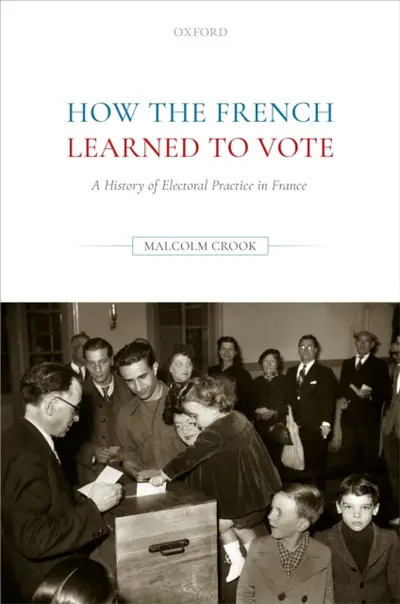
How the French Learned to Vote
A History of Electoral Practice in France
Price and availability
$104.99
Available in: Andorra, Austria, Australia, Belgium, Bulgaria, Canada, Switzerland, Cyprus, Czechia, Germany, Denmark, Estonia, Spain, Finland, France, United Kingdom, Guernsey, Greece, Croatia, Hungary, Ireland, Isle of Man, Iceland, Italy, Jersey, Japan, Liechtenstein, Lithuania, Luxembourg, Latvia, Monaco, Malta, Netherlands, Norway, Poland, Portugal, Romania, Sweden, Slovenia, Slovakia, San Marino, United States, Vatican City, South Africa
Stores: US, UK, Canada, EU, Australia.
Sign in to buyThe price is re-checked by the server before payment.
For personal use under the eBook licence.
- Format
- EPUB
- DRM
- Not stated by the publisher
- Language
- English
- Publisher
- Oxford University Press
- Published
- 26 March 2021
- ISBN
- 9780192647665
- Subjects
- France, European history, Modern history to 20th century: c 1700 to c 1900, Elections & referenda, Elections and referenda / suffrage, European history
About this book
The right to vote in regular elections is a fundamental principle of democracy. It constitutes a familiar civic ritual all over the world, yet few participants are probably aware of its long and controversial history. This was especially true of France, the country chosen for this study, which explores a wide range of issues surrounding voting in the context of a specific society. Casting a ballot does not come naturally and learning to vote is a lengthy process, like the achievement of free and fair elections which are open to all adults. An unprecedented experiment with mass voting for males was initiated in France in 1789, only for recurrent upheaval to ensure that the question of who could vote, including women besides men, and how they did so, was frequently addressed and amended. The entire electoral system was a constant source of partisan conflict, popular protest and innovation, throwing issues around the franchise, electoral corruption, spoiling papers and the problem of non-voting into especially sharp focus. This is the first book to explore these practices in a comprehensive fashion, from the perspective of ordinary people, beginning before the French Revolution and concluding with the present day, while according significant space to local as well as national elections. A thematic analysis will assist an understanding of those countries where democracy remains in its infancy, while also offering insight into widespread contemporary concern over declining turnout.
Bibliographic data © Gardners Books Ltd.