EPUB · English
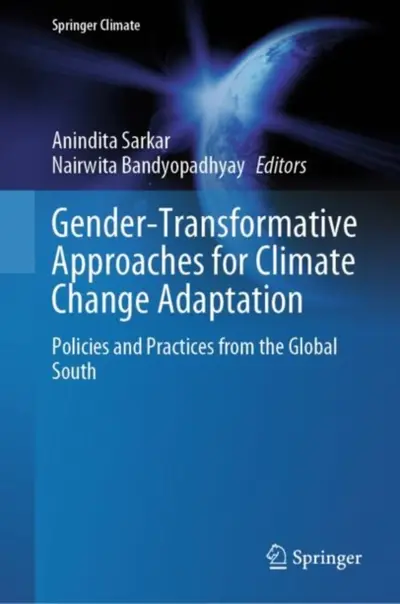
Gender-Transformative Approaches for Climate Change Adaptation
Policies and Practices from the Global South
Price and availability
$175.99
Available in: Andorra, Austria, Australia, Belgium, Bulgaria, Canada, Switzerland, Cyprus, Czechia, Germany, Denmark, Estonia, Spain, Finland, France, United Kingdom, Guernsey, Greece, Croatia, Hungary, Ireland, Isle of Man, Iceland, Italy, Jersey, Japan, Liechtenstein, Lithuania, Luxembourg, Latvia, Monaco, Malta, Netherlands, Norway, Poland, Portugal, Romania, Sweden, Slovenia, Slovakia, San Marino, United States, Vatican City, South Africa
Stores: US, UK, Canada, EU, Australia.
Sign in to buyThe price is re-checked by the server before payment.
For personal use under the eBook licence.
- Format
- EPUB
- DRM
- Not stated by the publisher
- Language
- English
- Publisher
- Springer Nature Switzerland
- Published
- 14 July 2025
- ISBN
- 9783031902369
- Subjects
- Developing countries, Gender studies, gender groups, Meteorology & climatology, Climate change, Gender studies, gender groups, Meteorology and climatology
About this book
This book offers an array of narratives and recommendations for gender-transformative climate change adaptation strategies based on research and evidence from the Global South. We look at gender-transformative adaptation (GTA) as a process that aims to address gender and power imbalance and strive for a change at the institutional level to enable empowering consequences through the meaningful and equal participation of women and men in leadership, policy, and decision-making processes. It makes four main contributions. First, it collates scholarship on the politics of adaptation and how policies affect men and women differently in communities and different geographical locations. Second, it captures pathways for parallel goals of `climate action' (SDG 13) and `achieving gender equality and empowerment' (SDG 5) through transformative ideas. Third, it curates new methodologies and adds knowledge to the gender transformative research (GTR) and assesses its potential for challenging and addressing gender power equations. Fourth, it voices the parallel ideas and evidence, placing women as both “victims of climate change” and as the “new change makers” in the path of climate adaptation.
Bibliographic data © Gardners Books Ltd.