PDF · English
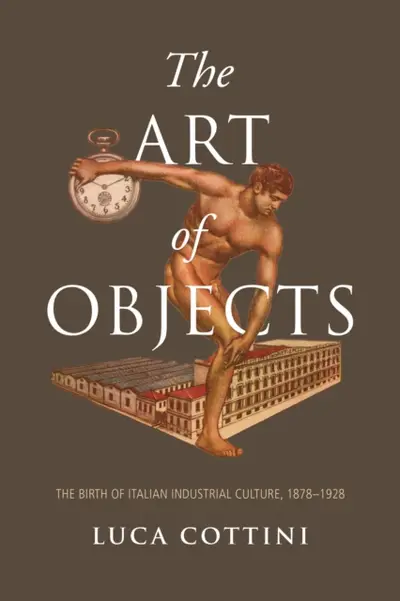
Art of Objects
The Birth of Italian Industrial Culture, 1878-1928
Price and availability
$82.99
Available in: Andorra, Austria, Australia, Belgium, Bulgaria, Canada, Switzerland, Cyprus, Czechia, Germany, Denmark, Estonia, Spain, Finland, France, United Kingdom, Guernsey, Greece, Croatia, Hungary, Ireland, Isle of Man, Iceland, Italy, Jersey, Japan, Liechtenstein, Lithuania, Luxembourg, Latvia, Monaco, Malta, Netherlands, Norway, Poland, Portugal, Romania, Sweden, Slovenia, Slovakia, San Marino, United States, Vatican City, South Africa
Stores: US, UK, Canada, EU, Australia.
Sign in to buyThe price is re-checked by the server before payment.
For personal use under the eBook licence.
- Format
- DRM
- Not stated by the publisher
- Language
- English
- Publisher
- University of Toronto Press
- Published
- 12 June 2018
- Pages
- 328
- ISBN
- 9781487516109
- Subjects
- Europe, Italy, Sardinia, Sicily, Italian, Industrial / commercial art & design, Individual designers, Literature: history & criticism, Literary studies: general, European history, Italian, Design, Industrial and commercial arts, illustration, Individual designers or design groups, Literature: history and criticism, Literary studies: general, NHD
About this book
The Art of Objects is a cultural history of early Italian industrialism, set against the political, social, and intellectual background of post-unification Italy, and a cutting-edge investigation of the formation of Italy's industrial culture at the turn of the twentieth century. Providing a close examination of several objects of mass consumption, including watches, photographs, bicycles, gramophones, cigarettes, and toys, author Luca Cottini explores the transformation of these objects from commercial items into aesthetic and philosophical icons.By focusing on the cultural significance of these objects as they enter the market and appear in contemporary works of art and literature, The Art of Objects outlines a comprehensive view of the age between the unification of Italy and Fascism, encompassing production and consumption, aesthetics and entrepreneurship, industry and the humanistic tradition. The observation of the slow formation of new languages, practices, and experiences around these objects also provides valuable insight into the creative laboratory of Italy's early industrial culture. By reconstructing the origins of the Italian culture of design, the book ultimately investigates Italy's critical reception of industrialism, the nation's so-called "e;imperfect"e; modernization, and its ongoing quest for an original way to modernity.
Bibliographic data © Gardners Books Ltd.