EPUB · English
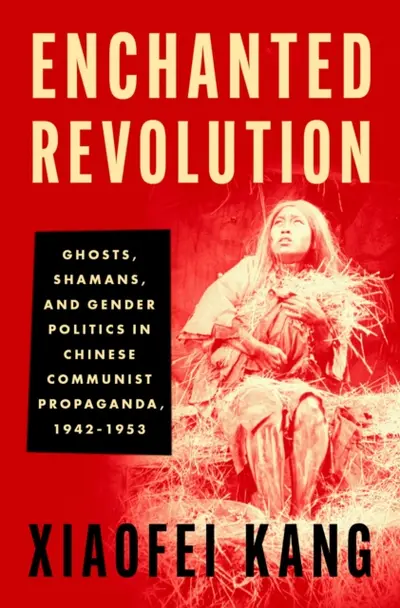
Enchanted Revolution
Ghosts, Shamans, and Gender Politics in Chinese Communist Propaganda, 1942-1953
Price and availability
$74.99
Available in: Andorra, Austria, Australia, Belgium, Bulgaria, Canada, Switzerland, Cyprus, Czechia, Germany, Denmark, Estonia, Spain, Finland, France, United Kingdom, Guernsey, Greece, Croatia, Hungary, Ireland, Isle of Man, Iceland, Italy, Jersey, Japan, Liechtenstein, Lithuania, Luxembourg, Latvia, Monaco, Malta, Netherlands, Norway, Poland, Portugal, Romania, Sweden, Slovenia, Slovakia, San Marino, United States, Vatican City, South Africa
Stores: US, UK, Canada, EU, Australia.
Sign in to buyThe price is re-checked by the server before payment.
For personal use under the eBook licence.
- Format
- EPUB
- DRM
- Not stated by the publisher
- Language
- English
- Publisher
- Oxford University Press
- Published
- 2 June 2023
- ISBN
- 9780197654491
- Subjects
- Asia, China, Chinese, 20th century, c 1945 to c 2000 (Post-war period), Asian history, Postwar 20th century history, from c 1945 to c 2000, Religion & politics, Geopolitics, Chinese, 3MP, 3MPQ, Geopolitics, NH, NHF, QRAM2
About this book
Enchanted Revolution moves religion and gender to center stage in the Chinese Communist revolution, examining the mobilizational dynamics of anti-superstition propaganda in support of the Communist Party's rise from rural backwaters to national dominance. Xiaofei Kang argues that religion was not merely adversary for the revolutionaries-it also served as a model for the ways in which the Party mobilized support and constructed legitimacy. In this parallel and often paradoxical process, the Party attacked superstitions that had long supported the foundations of Chinese religious life. At the same time, Party propaganda co-opted these same religious resources for its own political ends. Kang demonstrates that the persuasive power of Party propaganda relied heavily on recasting the cosmic forces of yin and yang that sustained the traditional gender hierarchy and ritual order. Moreover, revolutionary art and literature revamped old narratives of female ghosts and ritual exorcism to inject the people with a new masculinist vision of the Party-state endowed with both scientific potency and the heavenly mandate. Gendered language and symbolism in Chinese religion thus remained central to inspiring pathos, ethos, and logos for the revolution. Enchanted Revolution sheds light on the contemporary significance of the Maoist legacy in China through a deft exploration of the complex interplay of religion, gender, and revolution.
Bibliographic data © Gardners Books Ltd.