EPUB · English
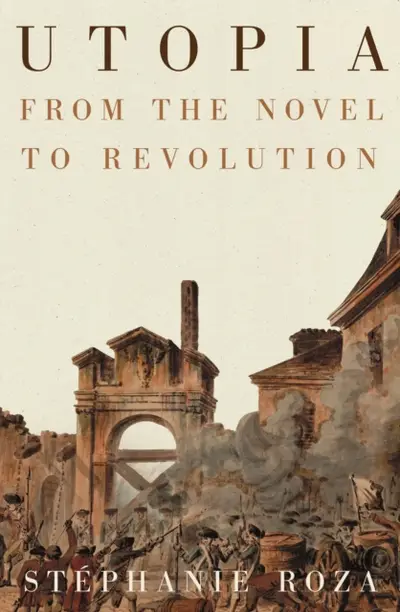
Utopia
From the Novel to Revolution
Price and availability
Not sold in this region
Available in: Andorra, Austria, Australia, Belgium, Bulgaria, Switzerland, Cyprus, Czechia, Germany, Denmark, Estonia, Spain, Finland, France, United Kingdom, Guernsey, Greece, Croatia, Hungary, Ireland, Isle of Man, Iceland, Italy, Jersey, Japan, Liechtenstein, Lithuania, Luxembourg, Latvia, Monaco, Malta, Netherlands, Norway, Poland, Portugal, Romania, Sweden, Slovenia, Slovakia, San Marino, Vatican City, South Africa
Stores: UK, EU, Australia. Not available in the United States store.
This title cannot be bought in this store yet: its supplier terms, territorial rights or price are still being confirmed.
For personal use under the eBook licence.
- Format
- EPUB
- DRM
- Not stated by the publisher
- Language
- English
- Publisher
- Verso
- Published
- 1 July 2025
- ISBN
- 9781839767661
- Subjects
- France, c 1700 to c 1800, Literature: history & criticism, Revolutionary groups & movements, France, Literature: history and criticism, Revolutionary groups and movements
About this book
Until the Age of Enlightenment, utopia was a popular literary genre, but without concrete political effects. However, in the decades leading up to 1789, its status gradually changed from an entertaining thought experiment to a socialist project. Imagining the ideal city took on the task of articulating revolutionary transformation of society towards equality and social justice.In Utopia, St,phanie Roza explores the nascent ideal of a community of property and labour, not yet called communism, and the thinkers who engaged with it in the lead-up to the French Revolution. These philosophers included ,tienne-Gabriel Morelly, a fierce critic of private property and the mysterious author of the Code de la Nature; the Abb, de Mably, a radical republican and interlocutor of Rousseau; and Gracchus Babeuf, who, from the 1780s onwards, defended the natural right to subsistence and dreamed of a more fraternal world.Together, they laid the foundations for modern socialist movements. In the crucible of the French Revolution, 'real equality' became the goal of a handful of conspirators gathered around Babeuf, who had meanwhile become the 'tribune of the people'. The Conspiracy of Equals was considered by Marx to be 'the first active communist party': the hopes and questions that ran through the group prefigured those of the militants of later periods, including today.
Bibliographic data © Gardners Books Ltd.