PDF · English
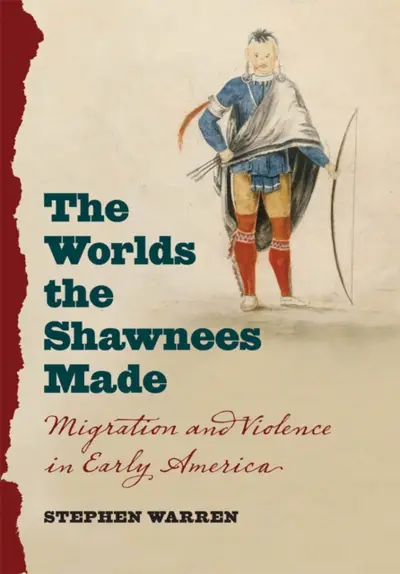
Worlds the Shawnees Made
Migration and Violence in Early America
Price and availability
$81.99
Available in: Andorra, Austria, Australia, Belgium, Bulgaria, Canada, Switzerland, Cyprus, Czechia, Germany, Denmark, Estonia, Spain, Finland, France, United Kingdom, Guernsey, Greece, Croatia, Hungary, Ireland, Isle of Man, Iceland, Italy, Jersey, Japan, Liechtenstein, Lithuania, Luxembourg, Latvia, Monaco, Malta, Netherlands, Norway, Poland, Portugal, Romania, Sweden, Slovenia, Slovakia, San Marino, United States, Vatican City, South Africa
Stores: US, UK, Canada, EU, Australia.
Sign in to buyThe price is re-checked by the server before payment.
For personal use under the eBook licence.
- Format
- DRM
- Not stated by the publisher
- Language
- English
- Publisher
- The University of North Carolina Press
- Published
- 15 January 2014
- ISBN
- 9781469612768
- Subjects
- USA, Southeastern & South Atlantic states, North Central & Mid-West states, Ancient Rome, Semantics, discourse analysis, etc, General & world history, History of the Americas, Ancient history: to c 500 CE, Social & cultural history, Indigenous peoples, US Midwest, US Northeast: Mid-Atlantic States, Indigenous peoples / Indigeneity, History of the Americas, Social and cultural history, Local history
About this book
In 1779, Shawnees from Chillicothe, a community in the Ohio country, told the British, "e;We have always been the frontier."e; Their statement challenges an oft-held belief that American Indians derive their unique identities from longstanding ties to native lands. By tracking Shawnee people and migrations from 1400 to 1754, Stephen Warren illustrates how Shawnees made a life for themselves at the crossroads of empires and competing tribes, embracing mobility and often moving willingly toward violent borderlands. By the middle of the eighteenth century, the Shawnees ranged over the eastern half of North America and used their knowledge to foster notions of pan-Indian identity that shaped relations between Native Americans and settlers in the revolutionary era and beyond. Warren's deft analysis makes clear that Shawnees were not anomalous among Native peoples east of the Mississippi. Through migration, they and their neighbors adapted to disease, warfare, and dislocation by interacting with colonizers as slavers, mercenaries, guides, and traders. These adaptations enabled them to preserve their cultural identities and resist coalescence without forsaking their linguistic and religious traditions.
Bibliographic data © Gardners Books Ltd.