PDF · English
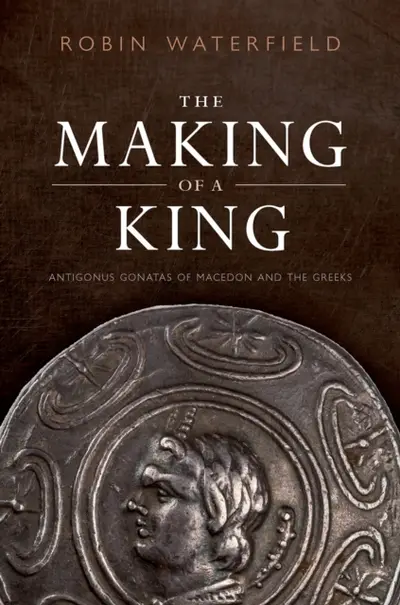
Making of a King
Antigonus Gonatas of Macedon and the Greeks
Price and availability
Not sold in this region
Available in: Andorra, Austria, Australia, Belgium, Bulgaria, Canada, Switzerland, Cyprus, Czechia, Germany, Denmark, Estonia, Spain, Finland, France, United Kingdom, Guernsey, Greece, Croatia, Hungary, Ireland, Iceland, Italy, Jersey, Liechtenstein, Lithuania, Luxembourg, Latvia, Monaco, Malta, Netherlands, Norway, Poland, Portugal, Romania, Sweden, Slovenia, Slovakia, San Marino, Vatican City, South Africa
Stores: UK, Canada, EU, Australia. Not available in the United States store.
This title cannot be bought in this store yet: its supplier terms, territorial rights or price are still being confirmed.
For personal use under the eBook licence.
- Format
- DRM
- Not stated by the publisher
- Language
- English
- Publisher
- Oxford University Press
- Published
- 23 September 2021
- ISBN
- 9780192594471
- Subjects
- Greece, Egypt, BCE to c 500 CE, European history, Ancient history: to c 500 CE, Classical history / classical civilisation, Greece, Egypt, Ancient history, European history
About this book
In the third century BCE, Macedon dominated mainland Greece, but was rapidly descending into chaos. One of the consequences was a massive invasion of Celts, who ravaged and plundered Macedon and northern Greece for several years. Antigonus Gonatas, son of one of Alexander the Great's Successors, finally defeated the Celts and laid the foundations for a long but troubled reign (276-239 BCE). In order to achieve stability, he adopted repressive measures towards many of the Greek cities. The Making of a King is the first book in more than a century to tell the gripping story of Antigonus' rule: how he gained the throne, how he held it, the nature of his court, the measures he took towards the Greeks, and their responses. While Antigonus was confirming his rule in Macedon by introducing constitutional changes there, the Greeks were making their own changes. Their only hope for independence lay in greater unity. Two great confederacies of Greek cities emerged: the Aetolians in central Greece, and the Achaeans in the Peloponnese. Robin Waterfield charts Antigonus' conflicts with the Greeks and with his perennial enemy, Ptolemy of Egypt. Successes, both diplomatic and military, against these enemies in the 260s and 250s BCE were not enough to gain him peace, and in his final years he saw his control of Greece whittled away by rebellion and the Greek confederacies. Ultimately, the lack of firm control of Greece by Macedon made it possible for Rome to take its place as the arbiter of the Greeks' future.
Bibliographic data © Gardners Books Ltd.