PDF · English
Egyptian Intelligence Service
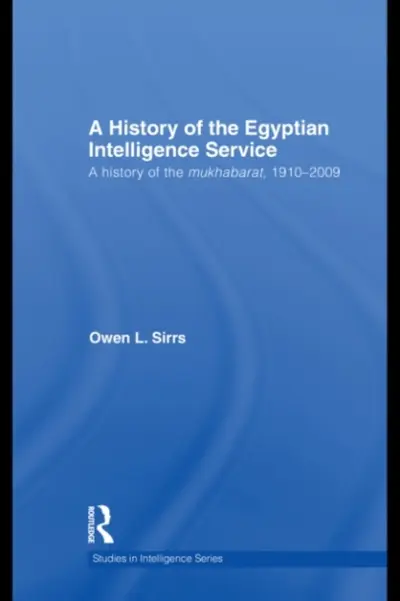
A History of the Mukhabarat, 1910-2009
Price and availability
$68.99
Available in: Andorra, Austria, Australia, Belgium, Bulgaria, Canada, Switzerland, Cyprus, Czechia, Germany, Denmark, Estonia, Spain, Finland, France, United Kingdom, Guernsey, Greece, Croatia, Hungary, Ireland, Isle of Man, Iceland, Italy, Jersey, Japan, Liechtenstein, Lithuania, Luxembourg, Latvia, Monaco, Malta, Netherlands, Norway, Poland, Portugal, Romania, Sweden, Slovenia, Slovakia, San Marino, United States, Vatican City, South Africa
Stores: US, UK, Canada, EU, Australia.
Sign in to buyThe price is re-checked by the server before payment.
For personal use under the eBook licence.
- Format
- DRM
- Not stated by the publisher
- Language
- English
- Publisher
- Taylor & Francis
- Published
- 25 February 2010
- ISBN
- 9781136991318
- Subjects
- Egypt, Middle Eastern history, African history, 20th century history: c 1900 to c 2000, Military history, Political control & freedoms, Egypt, Espionage and secret services, Middle Eastern history
About this book
This book analyzes how the Egyptian intelligence community has adapted to shifting national security threats since its inception 100 years ago. Starting in 1910, when the modern Egyptian intelligence system was created to deal with militant nationalists and Islamists, the book shows how the security services were subsequently reorganized, augmented and centralized to meet an increasingly sophisticated array of challenges, including fascism, communism, army unrest, Israel, France, the United Kingdom, conservative Arab states, the Muslim Brotherhood and others. The book argues that studying Egypt's intelligence community is integral to our understanding of that country's modern history, regime stability and human rights record. Intelligence studies have been described as the 'missing dimension' of international relations. It is clear that intelligence agencies are pivotal to understanding the nature of many Arab regimes and their decision-making processes, and there is no published history of modern Egyptian intelligence in either a European language or in Arabic, though Egypt has the largest and arguably most effective intelligence community in the Arab world.This book will fill a clear gap in the intelligence literature and will be of much interest to students of intelligence studies, Middle Eastern politics, international security and IR in general.
Bibliographic data © Gardners Books Ltd.