PDF · French
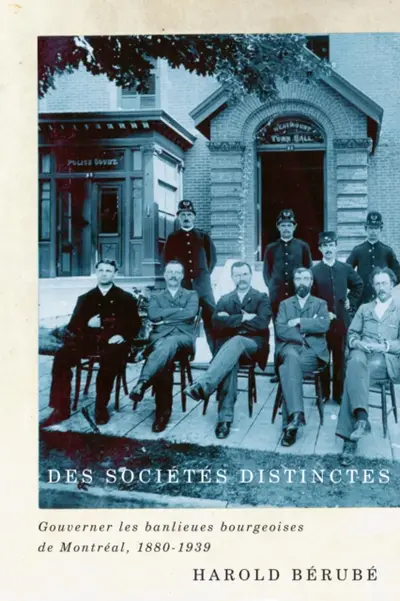
Des sociétés distinctes
Gouverner les banlieues bourgeoises de Montréal, 1880-1939
Price and availability
$39.99
Available in: Andorra, Austria, Australia, Belgium, Bulgaria, Canada, Switzerland, Cyprus, Czechia, Germany, Denmark, Estonia, Spain, Finland, France, United Kingdom, Guernsey, Greece, Croatia, Hungary, Ireland, Isle of Man, Iceland, Italy, Jersey, Japan, Liechtenstein, Lithuania, Luxembourg, Latvia, Monaco, Malta, Netherlands, Norway, Poland, Portugal, Romania, Sweden, Slovenia, Slovakia, San Marino, United States, Vatican City, South Africa
Stores: US, UK, Canada, EU, Australia.
Sign in to buyThe price is re-checked by the server before payment.
For personal use under the eBook licence.
- Format
- DRM
- Not stated by the publisher
- Language
- French
- Publisher
- McGill-Queen's University Press
- Published
- 1 December 2014
- ISBN
- 9780773596146
- Subjects
- Canada, c 1800 to c 1900, 20th century, Regional studies, History of the Americas, Political parties, Canada, 3MN, 3MP, History of scholarship (principally of social sciences and humanities), Political parties and party platforms, NHK
About this book
In 2006 fifteen suburban municipalities of Montreal partially regained the autonomy they lost during the 2002 mergers. The fact that most of these were affluent suburbs did not go unnoticed. Supporters of the "one island, one city" project saw the demerged municipalities as fiscal and linguistic enclaves refusing integration into the wider metropolitan community, but for merger opponents they represented the last political institutions of Quebec's anglophone community, with long-established local identities and distinct political cultures. Harold Bérubé studies three of these "distinct societies" - Westmount, Pointe-Claire, and Town of Mount Royal - between the end of the nineteenth century and the beginning of the Second World War, demonstrating that they were the stage for a distinctive form of suburban governance, rooted in the search for socioeconomic distinction in a quickly changing metropolitan environment. Through the use of local government, municipal politicians created a physical and social environment that clearly set them apart from the rest of the island and that conformed to a bourgeois suburban ideal. If they were indeed home to English-speaking majorities, what really defined their autonomy was affluence, an attention to town planning, and efficient governance - traits that became the foundations of strong local identities and that persist in the first decades of the twentieth century. An in-depth look into the roots of suburban democracy in Montreal, Des sociétés distinctes explores the desire to create and maintain distinct suburban communities as the surrounding expanding city encroached upon them and serves as an important historical backdrop to ideas about urban politics, collective identity, and municipal amalgamation.
Bibliographic data © Gardners Books Ltd.