PDF · English
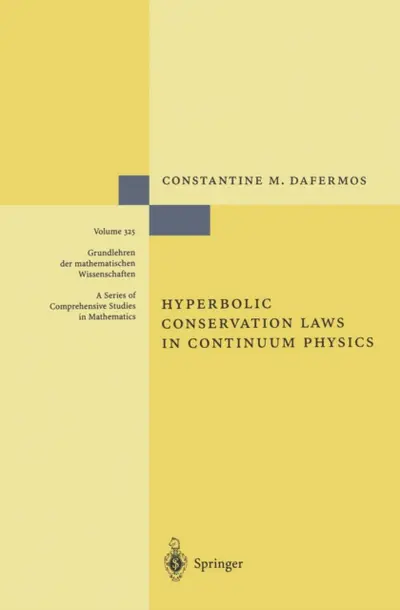
Hyperbolic Conservation Laws in Continuum Physics
Price and availability
$97.99
Available in: Andorra, Austria, Australia, Belgium, Bulgaria, Canada, Switzerland, Cyprus, Czechia, Germany, Denmark, Estonia, Spain, Finland, France, United Kingdom, Guernsey, Greece, Croatia, Hungary, Ireland, Isle of Man, Iceland, Italy, Jersey, Japan, Liechtenstein, Lithuania, Luxembourg, Latvia, Monaco, Malta, Netherlands, Norway, Poland, Portugal, Romania, Sweden, Slovenia, Slovakia, San Marino, United States, Vatican City, South Africa
Stores: US, UK, Canada, EU, Australia.
Sign in to buyThe price is re-checked by the server before payment.
For personal use under the eBook licence.
- Format
- DRM
- Not stated by the publisher
- Language
- English
- Publisher
- Springer Berlin Heidelberg
- Published
- 29 June 2013
- ISBN
- 9783662220191
- Subjects
- Differential calculus & equations, Classical mechanics, Thermodynamics & heat, Differential calculus and equations, Classical mechanics, Thermodynamics and heat
About this book
The seeds of Continuum Physics were planted with the works of the natural philosophers of the eighteenth century, most notably Euler; by the mid-nineteenth century, the trees were fully grown and ready to yield fruit. It was in this envi- ronment that the study of gas dynamics gave birth to the theory of quasilinear hyperbolic systems in divergence form, commonly called "e;hyperbolic conserva- tion laws"e;; and these two subjects have been traveling hand-in-hand over the past one hundred and fifty years. This book aims at presenting the theory of hyper- bolic conservation laws from the standpoint of its genetic relation to Continuum Physics. Even though research is still marching at a brisk pace, both fields have attained by now the degree of maturity that would warrant the writing of such an exposition. In the realm of Continuum Physics, material bodies are realized as continuous media, and so-called "e;extensive quantities"e;, such as mass, momentum and energy, are monitored through the fields of their densities, which are related by balance laws and constitutive equations. A self-contained, though skeletal, introduction to this branch of classical physics is presented in Chapter II. The reader may flesh it out with the help of a specialized text on the subject.
Bibliographic data © Gardners Books Ltd.