PDF · English
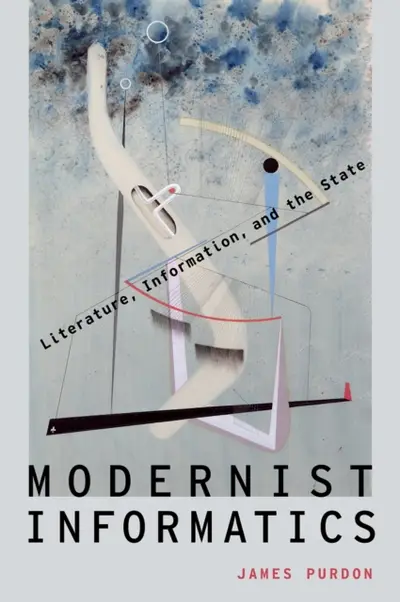
Modernist Informatics
Literature, Information, and the State
Price and availability
$78.99
Available in: Andorra, Austria, Australia, Belgium, Bulgaria, Canada, Switzerland, Cyprus, Czechia, Germany, Denmark, Estonia, Spain, Finland, France, United Kingdom, Guernsey, Greece, Croatia, Hungary, Ireland, Isle of Man, Iceland, Italy, Jersey, Japan, Liechtenstein, Lithuania, Luxembourg, Latvia, Monaco, Malta, Netherlands, Norway, Poland, Portugal, Romania, Sweden, Slovenia, Slovakia, San Marino, United States, Vatican City, South Africa
Stores: US, UK, Canada, EU, Australia.
Sign in to buyThe price is re-checked by the server before payment.
For personal use under the eBook licence.
- Format
- DRM
- Not stated by the publisher
- Language
- English
- Publisher
- Oxford University Press
- Published
- 2 November 2015
- ISBN
- 9780190211707
- Subjects
- United Kingdom, Great Britain, Literary studies: from c 1900 -, Communication studies, Media studies, Literary studies: c 1900 to c 2000, Communication studies, JBCT
About this book
Between steam and cybernetics lies a missing phase in the history of information culture. Beginning in the late nineteenth century, national governments and writers of fiction alike began to take an interest in information not simply as fact, nor yet as effortlessly transmissible data, but as an unusual and destabilizing new phenomenon. Modernist Informatics mines this burgeoning bureaucracy and marshals an array of archival evidence to detail the varied reactions of writers struggling in their lives and works to make sense of this strange new age of information. As James Purdon recounts in this fascinating study, many people, including Joseph Conrad and Walter Benjamin, felt the presence of information as an interruption rather than an enhancement of meaningful communication. Its intrusion provoked strong reactions from novelists such as Arnold Bennett, Ford Madox Ford, and Graham Greene. Each regarded the prying eyes of information society with increasing unease, as they struggled to overcome the division of daily existence between a fixed entity on a ledger and the imaginative possibility of everyday life. For others, such as Elizabeth Bowen, the nascent information age offered new opportunities for transforming experience into prose. Relating these varied, complex reactions and how they found their way into fiction, Purdon shows how historical changes shaped the narratives at his study's core and gave birth to a range of new informatic phenomena: passports and identity papers; the dossiers of the Mass-Observation movement; the literal and figurative blackout procedures of the Blitz; and the government-sponsored "e;information films"e; of John Grierson. Modernist Informatics ingeniously traces how information culture seeped into everyday lives, forging a relationship of entanglement as well as antagonism-a tension that was central to the shaping of modernity.
Bibliographic data © Gardners Books Ltd.