PDF · English
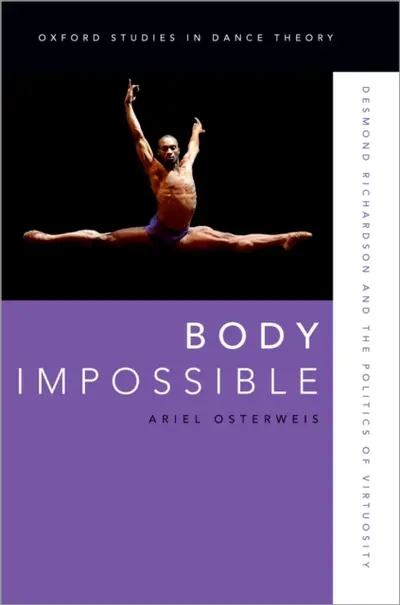
Body Impossible
Desmond Richardson and the Politics of Virtuosity
Price and availability
$29.99
Available in: Andorra, Austria, Australia, Belgium, Bulgaria, Canada, Switzerland, Cyprus, Czechia, Germany, Denmark, Estonia, Spain, Finland, France, United Kingdom, Guernsey, Greece, Croatia, Hungary, Ireland, Isle of Man, Iceland, Italy, Jersey, Japan, Liechtenstein, Lithuania, Luxembourg, Latvia, Monaco, Malta, Netherlands, Norway, Poland, Portugal, Romania, Sweden, Slovenia, Slovakia, San Marino, United States, Vatican City, South Africa
Stores: US, UK, Canada, EU, Australia.
Sign in to buyThe price is re-checked by the server before payment.
For personal use under the eBook licence.
- Format
- DRM
- Not stated by the publisher
- Language
- English
- Publisher
- Oxford University Press
- Published
- 23 April 2024
- ISBN
- 9780190645830
- Subjects
- USA, Dance, Biography: arts & entertainment, Gender studies, gender groups, Ethnic studies, United States of America, USA, ATQ, DNBF, JBSF, JBSL
About this book
Body Impossible theorizes the concept of virtuosity in contemporary dance and performance through a study of the career of dancer Desmond Richardson. A virtuoso for the ages, Richardson is renowned for delivering commanding performances over decades in contexts ranging from the stages of the Alvin Ailey American Dance Theater and Ballett Frankfurt to featured appearances with Michael Jackson and Prince, along with his work as co-founder of Complexions Contemporary Ballet, inaugurating a virtuosic queer black aesthetic with choreographer Dwight Rhoden. Focusing on Richardson's creative insistence on improvisatory fun and excellence throughout the decades approaching the millennium (shaped by Reaganism, the Culture Wars, the AIDS epidemic, the New Jim Crow, and MTV), this book brings dance into conversation with paradigms of blackness, queerness, masculinity, and class in order to generate a socioculturally attentive understanding of virtuosity. Virtuosity obscures the border between popular and concert performance, and Richardson's versatility epitomizes the demands on the contemporary virtuosic dance artist. Author Ariel Osterweis suggests that discourses of virtuosity are linked to connotations of excess, and that an examination of the formal and socio-cultural aspects of virtuosic performance reveals under-recognized heterogeneity in which we detect vernacular influences on high art. In doing so, Body Impossible accounts for the constitutive relationship between disciplined perceptions of virtuosity's excess and the disciplining of the racialized body in national and transnational contexts.
Bibliographic data © Gardners Books Ltd.