PDF · English
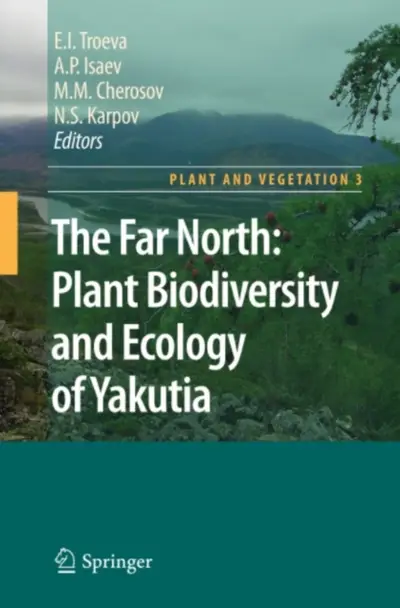
Far North:
Plant Biodiversity and Ecology of Yakutia
Price and availability
$242.99
Available in: Andorra, Austria, Australia, Belgium, Bulgaria, Canada, Switzerland, Cyprus, Czechia, Germany, Denmark, Estonia, Spain, Finland, France, United Kingdom, Guernsey, Greece, Croatia, Hungary, Ireland, Isle of Man, Iceland, Italy, Jersey, Japan, Liechtenstein, Lithuania, Luxembourg, Latvia, Monaco, Malta, Netherlands, Norway, Poland, Portugal, Romania, Sweden, Slovenia, Slovakia, San Marino, United States, Vatican City, South Africa
Stores: US, UK, Canada, EU, Australia.
Sign in to buyThe price is re-checked by the server before payment.
For personal use under the eBook licence.
- Format
- DRM
- Not stated by the publisher
- Language
- English
- Publisher
- Springer Netherlands
- Published
- 28 January 2010
- ISBN
- 9789048137749
- Subjects
- Plant ecology, Meteorology & climatology, Biodiversity, Forestry & silviculture: practice & techniques, Ecological science, the Biosphere, Evolution / Evolutionary biology, Plant biology, Meteorology and climatology, Biodiversity / Ecosystems, Forestry and silviculture
About this book
Outside Russia very little is known about the terrestrial ecology, vegetation, biogeographical patterns, and biodiversity of the enormously extensive ecosystems of Yakutia, Siberia. These systems are very special in that they function on top of huge layers of permafrost and are exposed to very severe and extreme weather conditions, the range between winter and summer temperatures being more than 100 degrees C. The soils are generally poor, and human use of the vegetation is usually extensive. Main vegetation zones are taiga and tundra, but Yakutia also supports a special land and vegetation form, caused by permafrost, the alas: more or less extensive grasslands around roundish lakes in taiga. All these vegetation types will be described and their ecology and ecophysiological characteristics will be dealt with. Because of the size of Yakutia, covering several climatic zones, and its extreme position on ecological gradients, Yakutia contains very interesting biogeographical patterns, which also will be described. Our analyses are drawn from many years of research in Yakutia and from a vast body of ecological and other literature in Russian publications and in unpublished local reports. The anthropogenic influence on the ecosystems will be dealt with. This includes the main activities of human interference with nature: forestry, extensive reindeer herding, cattle and horse grazing, etc. Also fire and other prominent ecological factors are dealt with. A very important point is also the very high degree of naturalness that is still extant in Yakutia's main vegetation zones.
Bibliographic data © Gardners Books Ltd.