EPUB · English
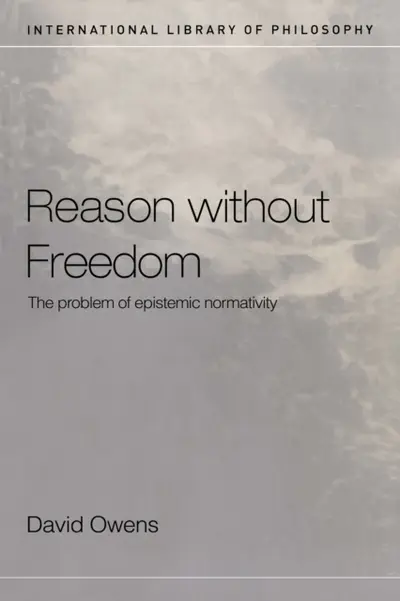
Reason Without Freedom
The Problem of Epistemic Normativity
Price and availability
$59.99
Available in: Andorra, Austria, Australia, Belgium, Bulgaria, Canada, Switzerland, Cyprus, Czechia, Germany, Denmark, Estonia, Spain, Finland, France, United Kingdom, Guernsey, Greece, Croatia, Hungary, Ireland, Isle of Man, Iceland, Italy, Jersey, Japan, Liechtenstein, Lithuania, Luxembourg, Latvia, Monaco, Malta, Netherlands, Norway, Poland, Portugal, Romania, Sweden, Slovenia, Slovakia, San Marino, United States, Vatican City, South Africa
Stores: US, UK, Canada, EU, Australia.
Sign in to buyThe price is re-checked by the server before payment.
For personal use under the eBook licence.
- Format
- EPUB
- DRM
- Not stated by the publisher
- Language
- English
- Publisher
- Taylor & Francis
- Published
- 1 November 2002
- ISBN
- 9781134593286
- Subjects
- Philosophy: epistemology & theory of knowledge, Philosophy of mind, Ethics & moral philosophy, Europe, Philosophy: epistemology and theory of knowledge, Philosophy of mind, Ethics and moral philosophy
About this book
We call beliefs reasonable or unreasonable, justified or unjustified. What does this imply about belief? Does this imply that we are responsible for our beliefs and that we should be blamed for our unreasonable convictions? Or does it imply that we are in control of our beliefs and that what we believe is up to us? Reason Without Freedom argues that the major problems of epistemology have their roots in concerns about our control over and responsibility for belief. David Owens focuses on the arguments of Descartes, Locke and Hume - the founders of epistemology - and presents a critical discussion of the current trends in contemporary epistemology. He proposes that the problems we confront today - scepticism, the analysis of knowlege, and debates on epistemic justification - can be tackled only once we have understood the moral psychology of belief. This can be resolved when we realise that our responsibility for beliefs is profoundly different from our rationality and agency, and that memory and testimony can preserve justified belief without preserving the evidence which might be used to justify it. Reason Without Freedom should be of value to those interested in contemporary epistemology, philosophy of mind and action, ethics, and the history of 17th and 18th century.
Bibliographic data © Gardners Books Ltd.