PDF · English
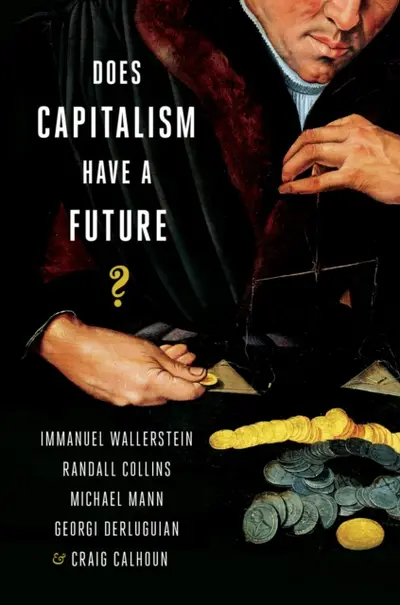
Does Capitalism Have a Future?
Price and availability
$36.99
Available in: Andorra, Austria, Australia, Belgium, Bulgaria, Canada, Switzerland, Cyprus, Czechia, Germany, Denmark, Estonia, Spain, Finland, France, United Kingdom, Guernsey, Greece, Croatia, Hungary, Ireland, Isle of Man, Iceland, Italy, Jersey, Japan, Liechtenstein, Lithuania, Luxembourg, Latvia, Monaco, Malta, Netherlands, Norway, Poland, Portugal, Romania, Sweden, Slovenia, Slovakia, San Marino, United States, Vatican City, South Africa
Stores: US, UK, Canada, EU, Australia.
Sign in to buyThe price is re-checked by the server before payment.
For personal use under the eBook licence.
- Format
- DRM
- Not stated by the publisher
- Language
- English
- Publisher
- Oxford University Press
- Published
- 21 October 2013
- ISBN
- 9780199330867
- Subjects
- Politics & government, Macroeconomics, Political economy, Economic systems & structures, Politics and government, Macroeconomics, Political economy, Economic systems and structures
About this book
In Does Capitalism Have a Future?, a global quintet of distinguished scholars cut their way through to the question of whether our capitalist system can survive in the medium run. Despite the current gloom, conventional wisdom still assumes that there is no real alternative to capitalism. The authors argue that this generalization is a mistaken outgrowth of the optimistic nineteenth-century claim that human history ascends through stages to an enlightened equilibrium of liberal capitalism. All major historical systems have broken down in the end, and in the modern epoch several cataclysmic events-notably the French revolution, World War I, and the collapse of the Soviet bloc-came to pass when contemporary political elites failed to calculate the consequences of the processes they presumed to govern. At present, none of our governing elites and very few intellectuals can fathom a systemic collapse in the coming decades. While the book's contributors arrive at different conclusions, they are in constant dialogue with one another, and they construct a relatively seamless-if open-ended-whole. Written by five of world's most respected scholars of global historical trends, this ambitious book asks the most important of questions: are we on the cusp of a radical world historical shift?
Bibliographic data © Gardners Books Ltd.