EPUB · English
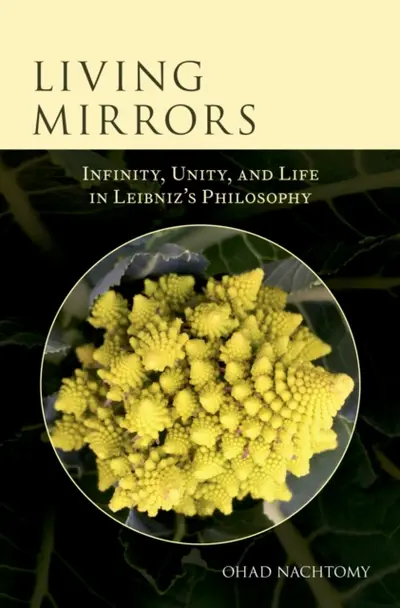
Living Mirrors
Infinity, Unity, and Life in Leibniz's Philosophy
Price and availability
$90.99
Available in: Andorra, Austria, Australia, Belgium, Bulgaria, Canada, Switzerland, Cyprus, Czechia, Germany, Denmark, Estonia, Spain, Finland, France, United Kingdom, Guernsey, Greece, Croatia, Hungary, Ireland, Isle of Man, Iceland, Italy, Jersey, Japan, Liechtenstein, Lithuania, Luxembourg, Latvia, Monaco, Malta, Netherlands, Norway, Poland, Portugal, Romania, Sweden, Slovenia, Slovakia, San Marino, United States, Vatican City, South Africa
Stores: US, UK, Canada, EU, Australia.
Sign in to buyThe price is re-checked by the server before payment.
For personal use under the eBook licence.
- Format
- EPUB
- DRM
- Not stated by the publisher
- Language
- English
- Publisher
- Oxford University Press
- Published
- 29 March 2019
- ISBN
- 9780190907341
- Subjects
- Philosophy: metaphysics & ontology, Philosophy of religion, QDTJ, QRAB
About this book
In Living Mirrors, Ohad Nachtomy examines Leibniz's attempt to "e;re-enchant"e; the natural world-that is, to infuse life, purpose, and value into the very foundations of nature, a nature that Leibniz saw as disenchanted by Descartes' and Spinoza's more naturalistic and mechanistic theories. Nachtomy sees Leibniz's nuanced view of infinity- how it differs in the divine as well as human spheres, and its relationship to numerical and metaphysical unity-as key in this effort. Leibniz defined living beings by means of an infinite nested structure particular to what he called "e;natural machines"e;-and for him, an intermediate kind of infinity is the defining feature of living beings. Using a metaphor of a "e;living mirror,"e; Leibniz put forth infinity as crucial to explaining the unity of a living being as well as the harmony between the infinitely small and the infinitely large; in this way, employing infinity and unity, we can better understand life itself, both as a metaphysical principle and as an empirical fact. Nachtomy's sophisticated and novel treatment of the essential themes in Leibniz's work will not only interest Leibniz scholars, but scholars of early modern philosophy and students of the history of philosophy and science as well.
Bibliographic data © Gardners Books Ltd.