PDF · English
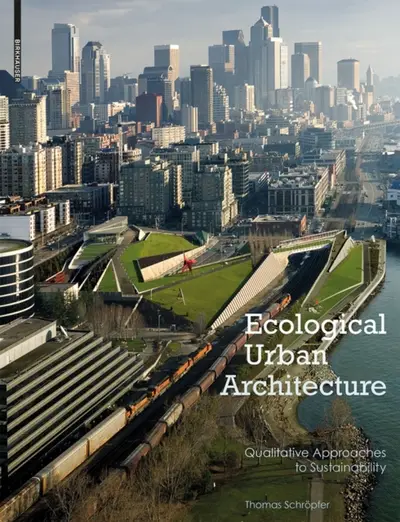
Ecological Urban Architecture
Qualitative Approaches to Sustainability
Price and availability
$70.99
Available in: Andorra, Austria, Australia, Belgium, Bulgaria, Canada, Switzerland, Cyprus, Czechia, Germany, Denmark, Estonia, Spain, Finland, France, United Kingdom, Guernsey, Greece, Croatia, Hungary, Ireland, Isle of Man, Iceland, Italy, Jersey, Japan, Liechtenstein, Lithuania, Luxembourg, Latvia, Monaco, Malta, Netherlands, Norway, Poland, Portugal, Romania, Sweden, Slovenia, Slovakia, San Marino, United States, Vatican City, South Africa
Stores: US, UK, Canada, EU, Australia.
Sign in to buyThe price is re-checked by the server before payment.
For personal use under the eBook licence.
- Format
- DRM
- Not stated by the publisher
- Language
- English
- Publisher
- Birkhauser
- Published
- 13 December 2012
- ISBN
- 9783034611756
- Subjects
- Architecture, Architectural structure & design, Environmentally-friendly architecture & design, City & town planning - architectural aspects, Engineering: general, Environmentally-friendly and sustainable architecture and design, City and town planning: architectural aspects, Engineering: general
About this book
The goal of advancing eco cities often remains confined to political or technological issues. This book establishes a focus on architectural and infrastructural design approaches to sustainable urban development. Taking as a basis the critical assessment of the five prototypical eco cities of Vauban/Freiburg, solarCity/Linz, Valdespartera, Sarriguren/Pamplona und Bo01/Malmo., the book identifies fields in which architectural and urban designers can use their creative skills and methods to achieve sustainable results on the urban scale. The themes of Materialize, Mobilize, Simulate and Transform highlight the shift from the manipulation of quantitative variables to interactive relationships effecting qualitative outcomes in design. For example, Materialize explores the potential of eco-design beyond the traditional palette of materials to show how spatial boundaries can be re-imagined as gradients of conditioned versus unconditioned space, working with climatic conditions rather than material boundaries to help generate new forms of urban architecture.
Bibliographic data © Gardners Books Ltd.