EPUB · English
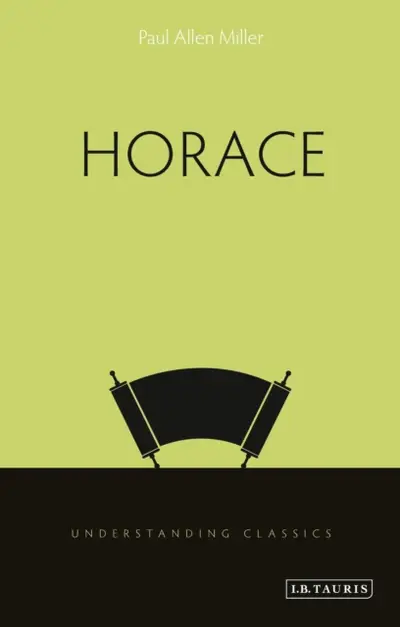
Horace
Price and availability
$24.99
Available in: Andorra, Austria, Australia, Belgium, Bulgaria, Canada, Switzerland, Cyprus, Czechia, Germany, Denmark, Estonia, Spain, Finland, France, United Kingdom, Guernsey, Greece, Croatia, Hungary, Ireland, Isle of Man, Iceland, Italy, Jersey, Japan, Liechtenstein, Lithuania, Luxembourg, Latvia, Monaco, Malta, Netherlands, Norway, Poland, Portugal, Romania, Sweden, Slovenia, Slovakia, San Marino, United States, Vatican City, South Africa
Stores: US, UK, Canada, EU, Australia.
Sign in to buyThe price is re-checked by the server before payment.
For personal use under the eBook licence.
- Format
- EPUB
- DRM
- Not stated by the publisher
- Language
- English
- Publisher
- Bloomsbury Publishing
- Published
- 18 December 2018
- Pages
- 216
- ISBN
- 9781786725387
- Subjects
- Ancient Rome, Latin, Classical texts, Literary studies: classical, early & medieval, Literary studies: poetry & poets, Classical history / classical civilisation, 1QBAR, Latin, Ancient, classical and medieval texts, Literary studies: ancient, classical and medieval, Literary studies: poetry and poets, NHC
About this book
Perhaps no classical writer has been so consistently in vogue as Horace. Famous in his own lifetime as a close associate of the Emperor Octavian, to whom he dedicated several odes, Quintus Horatius Flaccus (65 8 BC) has never really been out of fashion. Petrarch, for example, modelled his letters on Horace's innovative Epistles, while also borrowing from his Roman forebear in composing his own Italian sonnets. The echo of Horace's voice can be found in almost every genre of medieval literature. And in later periods, this influence and popularity if anything increased. Yet, as Paul Allen Miller shows, while Horace may justifiably be called the poet for all seasons he is also in the end an enigma. His elusive, ironic contrariness is perhaps the true secret of his success. A cultured man of letters, he fought on the losing side of the Battle of Philippi (42 BC). A staunch Republican, he ended up eagerly (some said too eagerly) promoting the cause of Julio-Claudian imperialism. Viewed as the acme of Roman literary civilization, he was shaped by his Athens education at Plato's famous Academy. This new introduction reveals Horace in all his paradoxical genius and complexity.
Bibliographic data © Gardners Books Ltd.