PDF · English
Ducktown Smoke
The Fight over One of the South''s Greatest Environmental Disasters
- History
- Politics & law
- Nature, environment & geography
- Technology & engineering
- Lifestyle, food & travel
Price and availability
$27.99
Available in: Andorra, Austria, Australia, Belgium, Bulgaria, Canada, Switzerland, Cyprus, Czechia, Germany, Denmark, Estonia, Spain, Finland, France, United Kingdom, Guernsey, Greece, Croatia, Hungary, Ireland, Isle of Man, Iceland, Italy, Jersey, Japan, Liechtenstein, Lithuania, Luxembourg, Latvia, Monaco, Malta, Netherlands, Norway, Poland, Portugal, Romania, Sweden, Slovenia, Slovakia, San Marino, United States, Vatican City, South Africa
Stores: US, UK, Canada, EU, Australia.
Sign in to buyThe price is re-checked by the server before payment.
For personal use under the eBook licence.
- Format
- DRM
- Not stated by the publisher
- Language
- English
- Publisher
- The University of North Carolina Press
- Published
- 30 May 2011
- ISBN
- 9798890885159
- Subjects
- Central Southern states, History of the Americas, Legal history, Environmental management, Environmental science, engineering & technology, US South, Legal history, History of the Americas, Environmental science, engineering and technology, Local history
About this book
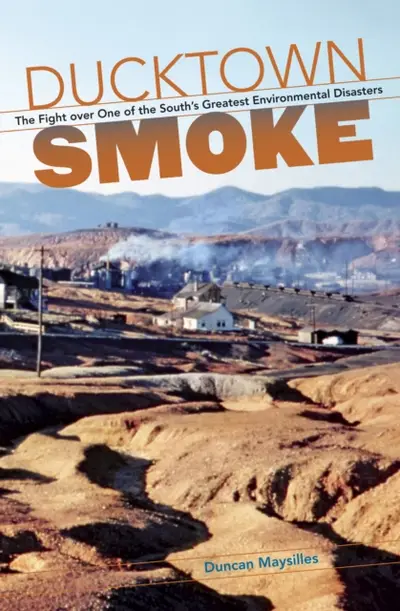
It is hard to make a desert in a place that receives sixty inches of rain each year. But after decades of copper mining, all that remained of the old hardwood forests in the Ducktown Mining District of the Southern Appalachian Mountains was a fifty-square mile barren expanse of heavily gullied red hills a landscape created by sulfur dioxide smoke from copper smelting and destructive logging practices. In Ducktown Smoke, Duncan Maysilles examines this environmental disaster, one of the worst the South has experienced, and its impact on environmental law and Appalachian conservation.Beginning in 1896, the widening destruction wrought in Tennessee, Georgia, and North Carolina by Ducktown copper mining spawned hundreds of private lawsuits, culminating in Georgia v. Tennessee Copper Co., the U.S. Supreme Courts first air pollution case. In its 1907 decision, the Court recognized for the first time the sovereign right of individual states to protect their natural resources from transborder pollution, a foundational opinion in the formation of American environmental law. Maysilles reveals how the Supreme Court case brought together the disparate forces of agrarian populism, industrial logging, and the forest conservation movement to set a legal precedent that remains relevant in environmental law today.
Bibliographic data © Gardners Books Ltd.