PDF · English
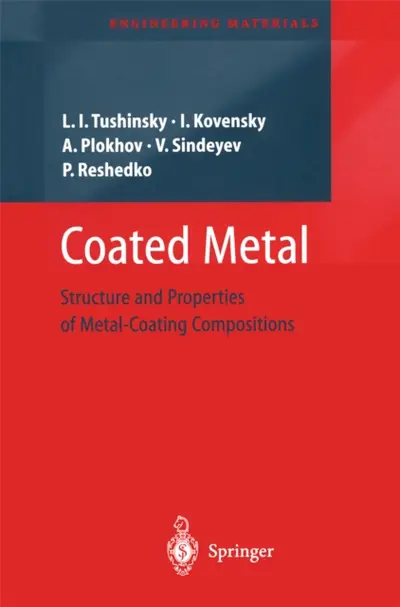
Coated Metal
Structure and Properties of Metal-Coating Compositions
Price and availability
$242.99
Available in: Andorra, Austria, Australia, Belgium, Bulgaria, Canada, Switzerland, Cyprus, Czechia, Germany, Denmark, Estonia, Spain, Finland, France, United Kingdom, Guernsey, Greece, Croatia, Hungary, Ireland, Isle of Man, Iceland, Italy, Jersey, Japan, Liechtenstein, Lithuania, Luxembourg, Latvia, Monaco, Malta, Netherlands, Norway, Poland, Portugal, Romania, Sweden, Slovenia, Slovakia, San Marino, United States, Vatican City, South Africa
Stores: US, UK, Canada, EU, Australia.
Sign in to buyThe price is re-checked by the server before payment.
For personal use under the eBook licence.
- Format
- DRM
- Not stated by the publisher
- Language
- English
- Publisher
- Springer Berlin Heidelberg
- Published
- 14 March 2013
- ISBN
- 9783662062760
- Subjects
- Surface-coating technology, Metals technology / metallurgy, Tribology (friction & lubrication), Materials science, Mechanics of solids, Production engineering, Tribology (friction and lubrication), Materials science, Engineering: Mechanics of solids, Engineering applications of surface coatings and films, Production and industrial engineering
About this book
Saving in metal, corrosion and wear control of machine parts are the problems of increasing priority. Conventional constructional materials are unable to provide re- liability and durability of equipment under conditions of increased working speeds and loads, aggressive medium attacks and elevated temperatures. Solution to these problems involves change in properties of the surface layers of products, in the first instance, by means of depositing functional coatings on machine parts. Rela- tive simplicity of the process and. practically unlimited possibilities of varying properties of coatings have resulted in their wide usage in machine building and transport industry, instrument engineering, radio electronics and other industries. Coating provides means for enhancing constructional strength of steels and al- loysl. It makes possible a combined method when one group of dislocation mechanisms is used for bulk hardening (grain refining, creation of stable sub- granular dislocation structures), while the working surface is hardened through other mechanisms (dislocation density increase, separation of excess phases, etc). Combined hardening saves valuable alloying components and provides reduction in metal consumption of machines and constructions. Coating allows manufacturing new composites that combine high durability (fatigue resistance, wear resistance) with sufficient reliability (fracture toughness); enhancement of operational stability of machine parts and tools as compared to stability attainable using conventional heat treatment methods; restoration of worn surfaces and, consequently, reduction in demand for spare parts.
Bibliographic data © Gardners Books Ltd.