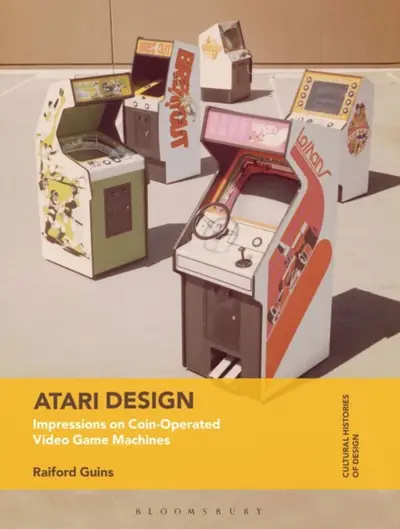
EPUB · English
Atari Design
Impressions on Coin-Operated Video Game Machines
Price and availability
$30.99
Available in: Andorra, Austria, Australia, Belgium, Bulgaria, Canada, Switzerland, Cyprus, Czechia, Germany, Denmark, Estonia, Spain, Finland, France, United Kingdom, Guernsey, Greece, Croatia, Hungary, Ireland, Isle of Man, Iceland, Italy, Jersey, Japan, Liechtenstein, Lithuania, Luxembourg, Latvia, Monaco, Malta, Netherlands, Norway, Poland, Portugal, Romania, Sweden, Slovenia, Slovakia, San Marino, United States, Vatican City, South Africa
Stores: US, UK, Canada, EU, Australia.
Sign in to buyThe price is re-checked by the server before payment.
For personal use under the eBook licence.
- Format
- EPUB
- DRM
- Not stated by the publisher
- Language
- English
- Publisher
- Bloomsbury Publishing
- Published
- 12 November 2020
- Pages
- 280
- ISBN
- 9781474284530
- Subjects
- History of art / art & design styles, Industrial / commercial art & design, Film, TV & radio, Media, information & communication industries, Graphical & digital media applications, AGA, Design, Industrial and commercial arts, illustration, ATF, Graphical and digital media applications, Media, entertainment, information and communication industries
About this book
Drawing from deep archival research and extensive interviews, Atari Design is a rich, historical study of how Atari's industrial and graphic designers contributed to the development of the video game machine.Innovative game design played a key role in the growth of Atari from Pong to Asteroids and beyond but fun, challenging and exciting game play was not unique to the famous Silicon Valley company. What set it apart from its competitors was innovation in the coin-op machine's cabinet. Atari did not just make games, it designed products for environments.With tasteful packaging , Atari exceeded traditional locations like bars, amusement parks and arcades, developing the look and feel of their game cabinets for new locations such as fast food restaurants, department stores, country clubs, university unions, and airports, making game-play a ubiquitous social and cultural experience. By actively shaping the interaction between user and machine, overcoming styling limitations and generating a distinct corporate identity, Atari designed products that impacted the everyday visual and material culture of the late 20th century. Design was never an afterthought at Atari.
Bibliographic data © Gardners Books Ltd.