EPUB · English
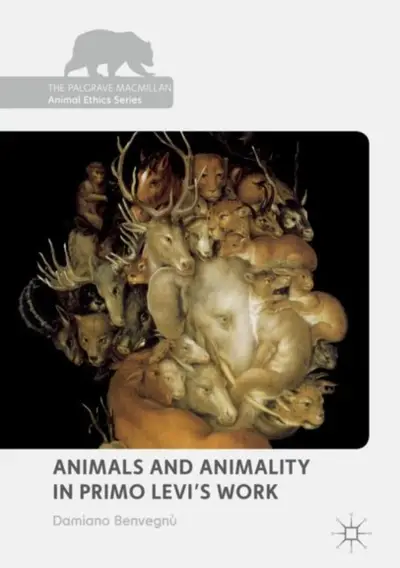
Animals and Animality in Primo Levi's Work
Price and availability
$94.99
Available in: Andorra, Austria, Australia, Belgium, Bulgaria, Canada, Switzerland, Cyprus, Czechia, Germany, Denmark, Estonia, Spain, Finland, France, United Kingdom, Guernsey, Greece, Croatia, Hungary, Ireland, Isle of Man, Iceland, Italy, Jersey, Japan, Liechtenstein, Lithuania, Luxembourg, Latvia, Monaco, Malta, Netherlands, Norway, Poland, Portugal, Romania, Sweden, Slovenia, Slovakia, San Marino, United States, Vatican City, South Africa
Stores: US, UK, Canada, EU, Australia.
Sign in to buyThe price is re-checked by the server before payment.
For personal use under the eBook licence.
- Format
- EPUB
- DRM
- Not stated by the publisher
- Language
- English
- Publisher
- Springer International Publishing
- Published
- 21 June 2018
- ISBN
- 9783319712581
- Subjects
- Literary studies: from c 1900 -, Philosophy: epistemology & theory of knowledge, Philosophy of mind, Ethics & moral philosophy, Bio-ethics, Literary studies: c 1900 to c 2000, Bioethics, Philosophy: epistemology and theory of knowledge, Philosophy of mind, Ethics and moral philosophy
About this book
Situated at the intersection of animal studies and literary theory, this book explores the remarkable and subtly pervasive web of animal imagery, metaphors, and concepts in the work of the Jewish-Italian writer, chemist, and Holocaust survivor Primo Levi (1919-1987). Relatively unexamined by scholars, the complex and extensive animal imagery Levi employed in his literary works offers new insights into the aesthetical and ethical function of testimony, as well as an original perspective on contemporary debates surrounding human-animal relationships and posthumanism. The three main sections that compose the book mirror Levi's approach to non-human animals and animality: from an unquestionable bio-ethical origin ("e;Suffering"e;); through an investigation of the relationships between writing, technology, and animality ("e;Techne"e;); to a creative intellectual project in which literary animals both counterbalance the inevitable suffering of all creatures, and suggest a transformative image of interspecific community ("e;Creation"e;).
Bibliographic data © Gardners Books Ltd.