PDF · English
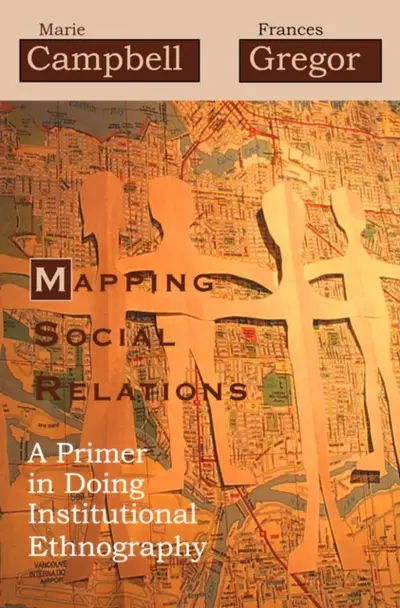
Mapping Social Relations
A Primer in Doing Institutional Ethnography
Price and availability
$27.99
Available in: Andorra, Austria, Australia, Belgium, Bulgaria, Canada, Switzerland, Cyprus, Czechia, Germany, Denmark, Estonia, Spain, Finland, France, United Kingdom, Guernsey, Greece, Croatia, Hungary, Ireland, Isle of Man, Iceland, Italy, Jersey, Japan, Liechtenstein, Lithuania, Luxembourg, Latvia, Monaco, Malta, Netherlands, Norway, Poland, Portugal, Romania, Sweden, Slovenia, Slovakia, San Marino, United States, Vatican City, South Africa
Stores: US, UK, Canada, EU, Australia.
Sign in to buyThe price is re-checked by the server before payment.
For personal use under the eBook licence.
- Format
- DRM
- Not stated by the publisher
- Language
- English
- Publisher
- University of Toronto Press
- Published
- 29 April 2013
- Pages
- 160
- ISBN
- 9781442602724
- Subjects
- Sociology & anthropology, Anthropology, Social & cultural anthropology, ethnography, Sociology and anthropology, Anthropology, Social and cultural anthropology
About this book
This is a book about a distinctive methodological approach inspired by one of Canada's most respected scholars, Dorothy Smith. Institutional ethnography aims to answer questions about how everyday life is organized. What is conventionally understood as "e;the relationship of micro to macro processes"e; is, in institutional ethnography, conceptualized and explored in terms of ruling relations. The authors suggest that institutional ethnographers must adopt a particular research stance, one that recognizes that people's own knolwedge and ways of knowing are crucial elements of social action and thus of social analysis. Specific attention to text analysis is integral to the approach.Institutional ethnography is remarkably well-suited to the human service curriculum and the training of professionals and activists. Its strategy for learning how to understand problems existing in everyday life appeals to many researchers who are looking for guidance on how to take practical action. At the same time, the highly elaborated theoretical foundation of institutional ethnography is difficult to deal with in the brief time most students are in the classroom. The authors successfully tackle the issue of teaching and applying institutional ethnography. Campbell and Gregor have been testing out instructional methods and materials for many years. Mapping Social Relations is the product of that effort.
Bibliographic data © Gardners Books Ltd.