EPUB · English
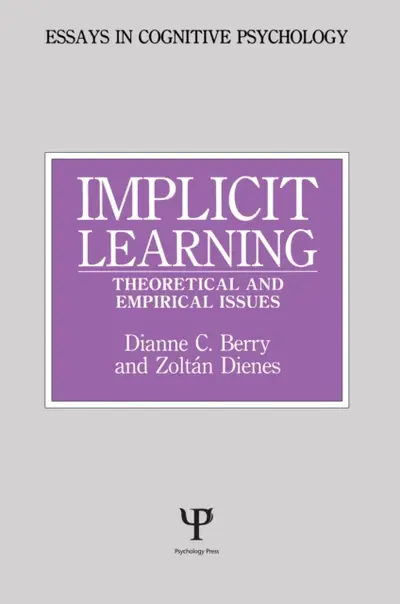
Implicit Learning
Theoretical and Empirical Issues
Price and availability
$85.99
Available in: Andorra, Austria, Australia, Belgium, Bulgaria, Canada, Switzerland, Cyprus, Czechia, Germany, Denmark, Estonia, Spain, Finland, France, United Kingdom, Guernsey, Greece, Croatia, Hungary, Ireland, Isle of Man, Iceland, Italy, Jersey, Japan, Liechtenstein, Lithuania, Luxembourg, Latvia, Monaco, Malta, Netherlands, Norway, Poland, Portugal, Romania, Sweden, Slovenia, Slovakia, San Marino, United States, Vatican City, South Africa
Stores: US, UK, Canada, EU, Australia.
Sign in to buyThe price is re-checked by the server before payment.
For personal use under the eBook licence.
- Format
- EPUB
- DRM
- Not stated by the publisher
- Language
- English
- Publisher
- Taylor & Francis
- Published
- 8 August 2019
- ISBN
- 9781317734864
- Subjects
- Psychology, Cognition & cognitive psychology, Physiological psychology, neuropsychology, biopsychology, Cognition and cognitive psychology, Artificial intelligence (AI)
About this book
There is considerable debate over the extent to which cognitive tasks can be learned non-consciously or implicitly. In recent years a large number of studies have demonstrated a discrepancy between explicit knowledge and measured performance. This book presents an overview of these studies and attempts to clarify apparently disparate results by placing them in a coherent theoretical framework. It draws on evidence from neuropsychological and computational modelling studies as well as the many laboratory experiments. Chapter one sets out the background to the large number of recent studies on implicit learning. It discusses research on implicit memory, perception without awareness, and automaticity. It attempts to set the implicit - explicit distinction in the context of other relevant dichotomies in the literature. Chapter two presents an overview of research on the control of complex systems, from Broadbent (1977) through to the present day. It looks at the accessibility of control task knowledge, as well as whether there is any other evidence for a distinction between implicit and explicit modes of learning. Chapter three critically reviews studies claiming to show that people can acquire concepts without being verbally aware of the basis on which they are responding. It shows that concept formation can be implicit in some sense but not in others. Chapter four investigates the claim that people can learn sequential information in an implicit way. Chapter five looks at whether computational modelling can elucidate the nature of implicit learning. It examines the feasibility of different exemplar connectionist models in accounting for performance in concept learning, sequence learning, and control task experiments. Chapter six reviews evidence concerning dissociations between implicit and explicit knowledge in various neuropsychological syndromes. Finally, chapters seven and eight discuss the many practical and theoretical implications of the research.
Bibliographic data © Gardners Books Ltd.