PDF · English
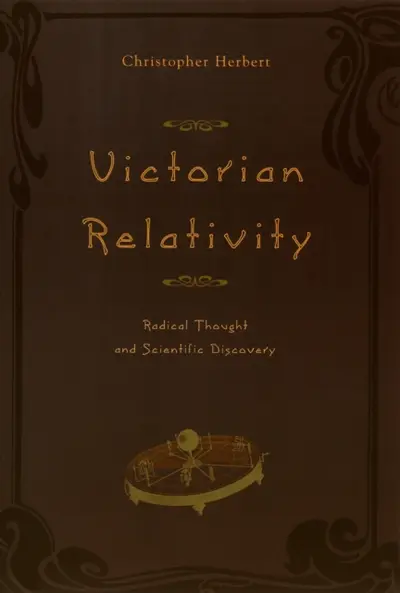
Victorian Relativity
Radical Thought and Scientific Discovery
Price and availability
$47.99
Available in: Andorra, Austria, Australia, Belgium, Bulgaria, Canada, Switzerland, Cyprus, Czechia, Germany, Denmark, Estonia, Spain, Finland, France, United Kingdom, Guernsey, Greece, Croatia, Hungary, Ireland, Isle of Man, Iceland, Italy, Jersey, Japan, Liechtenstein, Lithuania, Luxembourg, Latvia, Monaco, Malta, Netherlands, Norway, Poland, Portugal, Romania, Sweden, Slovenia, Slovakia, San Marino, United States, Vatican City, South Africa
Stores: US, UK, Canada, EU, Australia.
Sign in to buyThe price is re-checked by the server before payment.
For personal use under the eBook licence.
- Format
- DRM
- Not stated by the publisher
- Language
- English
- Publisher
- University of Chicago Press
- Published
- 15 November 2010
- ISBN
- 9780226327365
- Subjects
- c 1800 to c 1900, Literary studies: c 1800 to c 1900, Modern history to 20th century: c 1700 to c 1900, History of ideas, Science: general issues, History of science, Relativity physics, General and world history, Science: general issues, History of science, Relativity physics
About this book
One of the articles of faith of twentieth-century intellectual history is that the theory of relativity in physics sprang in its essentials from the unaided genius of Albert Einstein; another is that scientific relativity is unconnected to ethical, cultural, or epistemological relativisms. Victorian Relativity challenges these assumptions, unearthing a forgotten tradition of avant-garde speculation that took as its guiding principle "e;the negation of the absolute"e; and set itself under the militant banner of "e;relativity."e; Christopher Herbert shows that the idea of relativity produced revolutionary changes in one field after another in the nineteenth century. Surveying a long line of thinkers including Herbert Spencer, Charles Darwin, Alexander Bain, W. K. Clifford, W. S. Jevons, Karl Pearson, James Frazer, and Einstein himself, Victorian Relativity argues that the early relativity movement was bound closely to motives of political and cultural reform and, in particular, to radical critiques of the ideology of authoritarianism. Recuperating relativity from those who treat it as synonymous with nihilism, Herbert portrays it as the basis of some of our crucial intellectual and ethical traditions.
Bibliographic data © Gardners Books Ltd.