EPUB · English
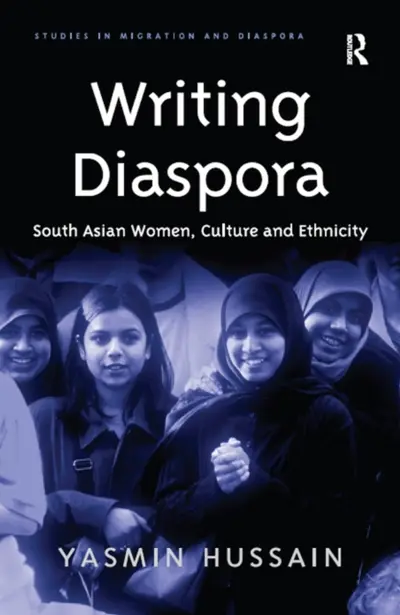
Writing Diaspora
South Asian Women, Culture and Ethnicity
Price and availability
$78.99
Available in: Andorra, Austria, Australia, Belgium, Bulgaria, Canada, Switzerland, Cyprus, Czechia, Germany, Denmark, Estonia, Spain, Finland, France, United Kingdom, Guernsey, Greece, Croatia, Hungary, Ireland, Isle of Man, Iceland, Italy, Jersey, Japan, Liechtenstein, Lithuania, Luxembourg, Latvia, Monaco, Malta, Netherlands, Norway, Poland, Portugal, Romania, Sweden, Slovenia, Slovakia, San Marino, United States, Vatican City, South Africa
Stores: US, UK, Canada, EU, Australia.
Sign in to buyThe price is re-checked by the server before payment.
For personal use under the eBook licence.
- Format
- EPUB
- DRM
- Not stated by the publisher
- Language
- English
- Publisher
- Taylor & Francis
- Published
- 2 March 2017
- ISBN
- 9781351870856
- Subjects
- English, Literature: history & criticism, Literary studies: general, Social & cultural history, Migration, immigration & emigration, Gender studies, gender groups, Ethnic studies, Sociology, United Kingdom, Great Britain, Literary studies: fiction, novelists and prose writers, Cultural studies, Ethnic studies / Ethnicity
About this book
Issues of cultural hybridity, diaspora and identity are central to debates on ethnicity and race and, over the past decade, have framed many theoretical debates in sociology, cultural studies and literary studies. However, these ideas are all too often considered at a purely theoretical level. In this book Yasmin Hussain uses these ideas to explore cultural production by British South Asian women including Monica Ali, Meera Syal and Gurinder Chadha. Hussain provides a sociological analysis of the contexts and experiences of the British South Asian community, discussing key concerns that emerge within the work of this new generation of women writers and which express more widespread debates within the community. In particular these authors address issues of individual and group identity and the ways in which these are affected by ethnicity and gender. Hussain argues that in exploring the different dimensions of their cultural heritage, the authors she surveys have created changes within the meaning of the diasporic identity, articulating a challenge to the notion of 'Asianness' as a homogenous and simple category. In her examination of the process through which a hybridized diasporic culture has come into being, she offers an important contribution to some of the key questions in recent sociological and cultural theory.
Bibliographic data © Gardners Books Ltd.