PDF · English
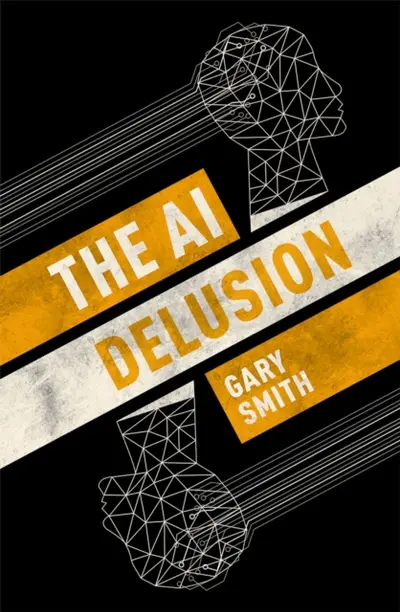
AI Delusion
Price and availability
$20.99
Available in: Andorra, Austria, Australia, Belgium, Bulgaria, Canada, Switzerland, Cyprus, Czechia, Germany, Denmark, Estonia, Spain, Finland, France, United Kingdom, Guernsey, Greece, Croatia, Hungary, Ireland, Isle of Man, Iceland, Italy, Jersey, Japan, Liechtenstein, Lithuania, Luxembourg, Latvia, Monaco, Malta, Netherlands, Norway, Poland, Portugal, Romania, Sweden, Slovenia, Slovakia, San Marino, United States, Vatican City, South Africa
Stores: US, UK, Canada, EU, Australia.
Sign in to buyThe price is re-checked by the server before payment.
For personal use under the eBook licence.
- Format
- DRM
- Not stated by the publisher
- Language
- English
- Publisher
- Oxford University Press
- Published
- 23 August 2018
- ISBN
- 9780192557797
- Subjects
- Impact of science & technology on society, Popular science, Ethical & social aspects of IT, Digital lifestyle, Artificial intelligence, Human-computer interaction, Popular science, Digital and information technologies: social and ethical aspects, Digital Lifestyle and online world: consumer and user guides, Artificial intelligence (AI), Human–computer interaction
About this book
We live in an incredible period in history. The Computer Revolution may be even more life-changing than the Industrial Revolution. We can do things with computers that could never be done before, and computers can do things for us that could never be done before. But our love of computers should not cloud our thinking about their limitations. We are told that computers are smarter than humans and that data mining can identify previously unknown truths, or make discoveries that will revolutionize our lives. Our lives may well be changed, but not necessarily for the better. Computers are very good at discovering patterns, but are useless in judging whether the unearthed patterns are sensible because computers do not think the way humans think. We fear that super-intelligent machines will decide to protect themselves by enslaving or eliminating humans. But the real danger is not that computers are smarter than us, but that we think computers are smarter than us and, so, trust computers to make important decisions for us. The AI Delusion explains why we should not be intimidated into thinking that computers are infallible, that data-mining is knowledge discovery, and that black boxes should be trusted.
Bibliographic data © Gardners Books Ltd.