EPUB · English
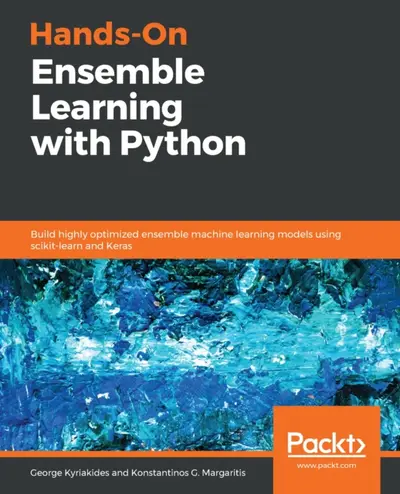
Hands-On Ensemble Learning with Python
Build highly optimized ensemble machine learning models using scikit-learn and Keras
Price and availability
$35.99
Available in: Andorra, Austria, Australia, Belgium, Bulgaria, Canada, Switzerland, Cyprus, Czechia, Germany, Denmark, Estonia, Spain, Finland, France, United Kingdom, Guernsey, Greece, Croatia, Hungary, Ireland, Isle of Man, Iceland, Italy, Jersey, Japan, Liechtenstein, Lithuania, Luxembourg, Latvia, Monaco, Malta, Netherlands, Norway, Poland, Portugal, Romania, Sweden, Slovenia, Slovakia, San Marino, United States, Vatican City, South Africa
Stores: US, UK, Canada, EU, Australia.
Sign in to buyThe price is re-checked by the server before payment.
For personal use under the eBook licence.
- Format
- EPUB
- DRM
- Not stated by the publisher
- Language
- English
- Publisher
- Packt Publishing
- Published
- 19 July 2019
- Pages
- 298
- ISBN
- 9781789617887
- Subjects
- Computer vision, Digital and Information technology: general topics, Database design and theory, Pattern recognition, Computer vision, Information architecture
About this book
Combine popular machine learning techniques to create ensemble models using PythonKey FeaturesImplement ensemble models using algorithms such as random forests and AdaBoostApply boosting, bagging, and stacking ensemble methods to improve the prediction accuracy of your model Explore real-world data sets and practical examples coded in scikit-learn and KerasBook DescriptionEnsembling is a technique of combining two or more similar or dissimilar machine learning algorithms to create a model that delivers superior predictive power. This book will demonstrate how you can use a variety of weak algorithms to make a strong predictive model.With its hands-on approach, you'll not only get up to speed on the basic theory but also the application of various ensemble learning techniques. Using examples and real-world datasets, you'll be able to produce better machine learning models to solve supervised learning problems such as classification and regression. Furthermore, you'll go on to leverage ensemble learning techniques such as clustering to produce unsupervised machine learning models. As you progress, the chapters will cover different machine learning algorithms that are widely used in the practical world to make predictions and classifications. You'll even get to grips with the use of Python libraries such as scikit-learn and Keras for implementing different ensemble models.By the end of this book, you will be well-versed in ensemble learning, and have the skills you need to understand which ensemble method is required for which problem, and successfully implement them in real-world scenarios.What you will learnImplement ensemble methods to generate models with high accuracyOvercome challenges such as bias and varianceExplore machine learning algorithms to evaluate model performanceUnderstand how to construct, evaluate, and apply ensemble modelsAnalyze tweets in real time using Twitter's streaming APIUse Keras to build an ensemble of neural networks for the MovieLens datasetWho this book is forThis book is for data analysts, data scientists, machine learning engineers and other professionals who are looking to generate advanced models using ensemble techniques. An understanding of Python code and basic knowledge of statistics is required to make the most out of this book.
Bibliographic data © Gardners Books Ltd.